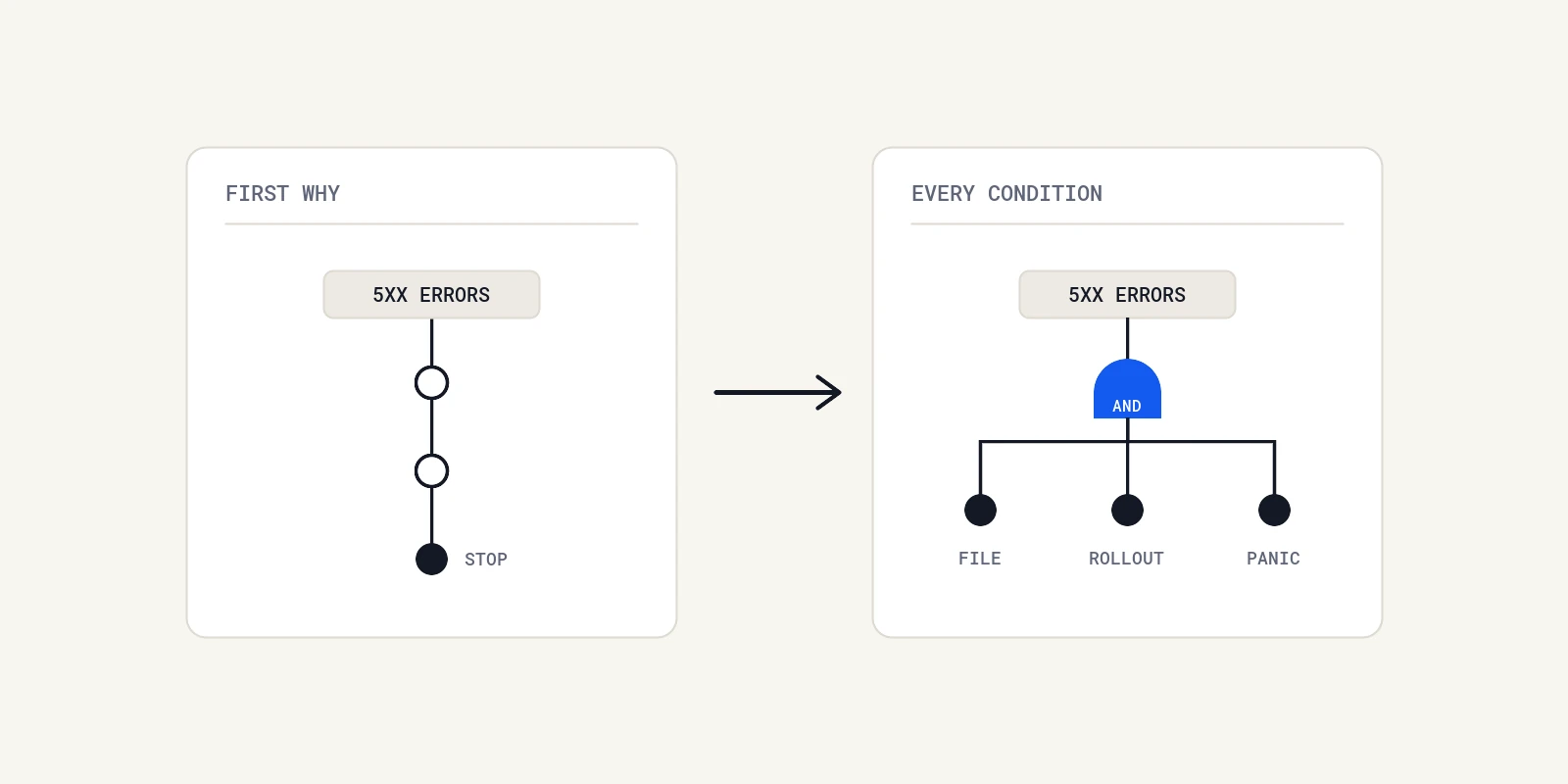
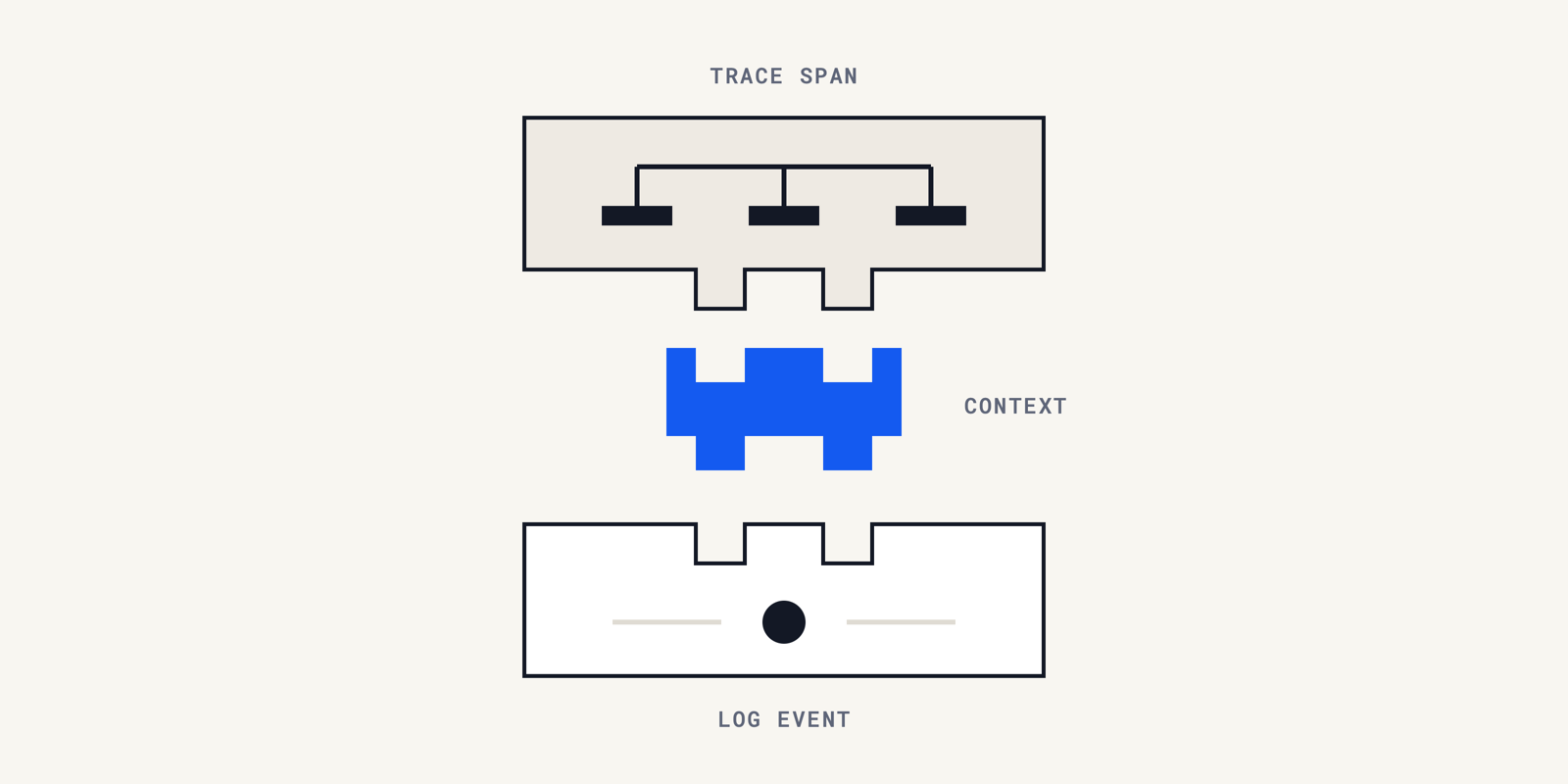
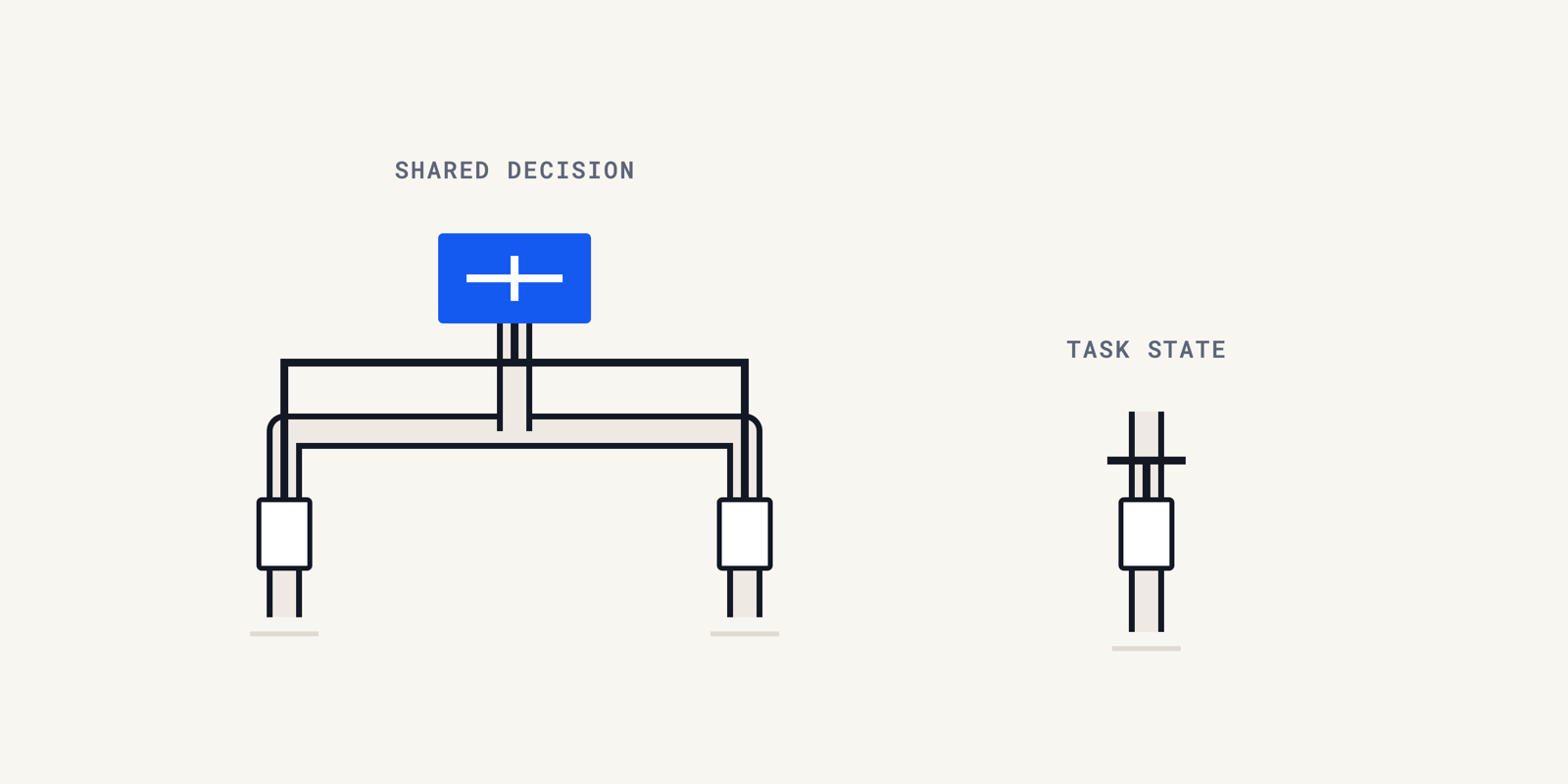
Incident and Problem Management Change Mean Time to Resolution
Compare incident and problem management, preserve restoration evidence, and correct cause links without distorting your resolution-time reports.
Quick Answer
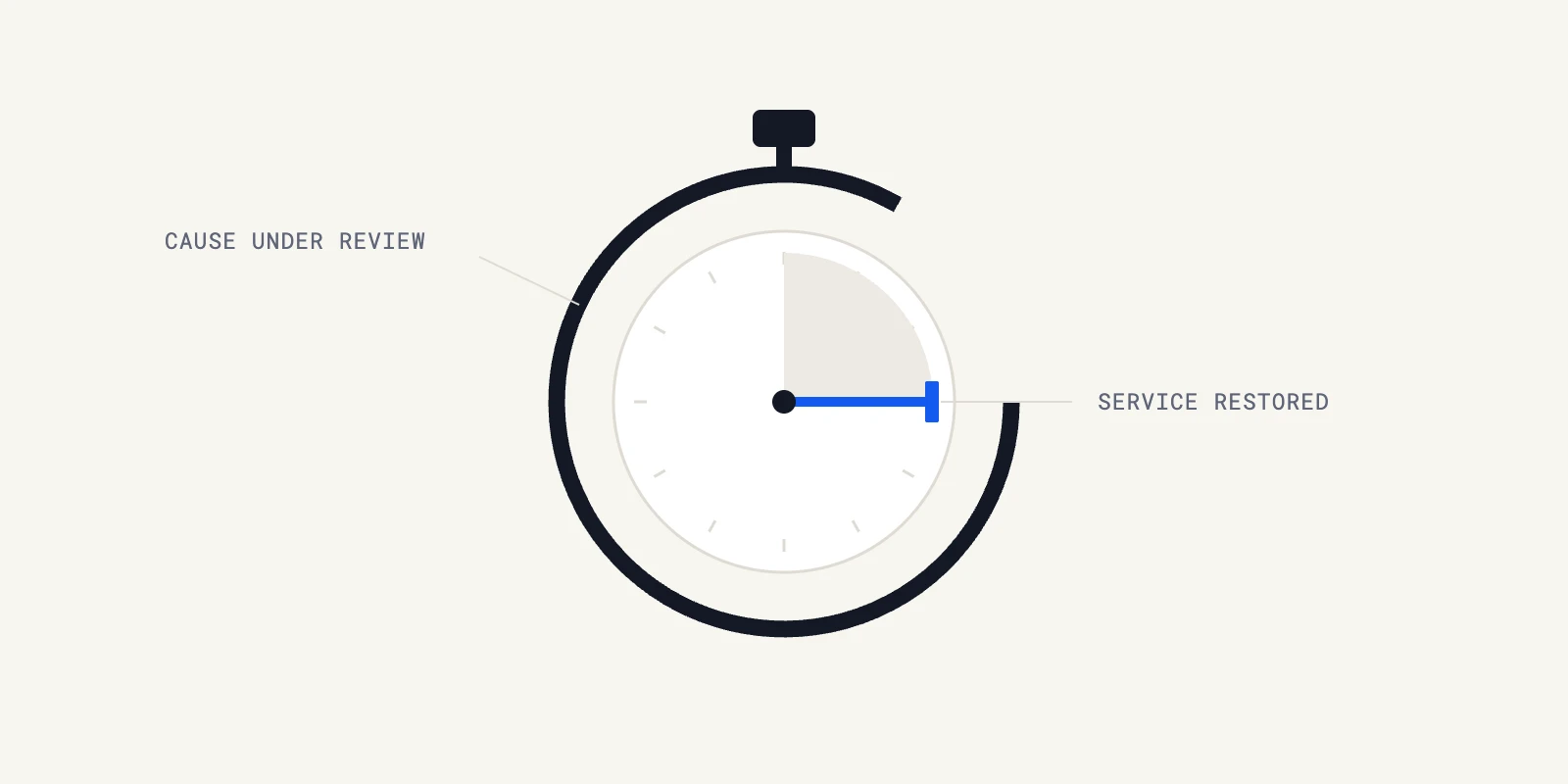
Incident and problem management need different completion evidence, so mean time to resolution needs an explicit endpoint. Restored service can coexist with an unresolved cause. Keep impact timestamps separate from changing incident-to-problem links, retain the evidence behind each revision, and calculate durations once per incident before joining related records. A renamed ticket, a merged problem or a rejected diagnosis should not silently change the reported customer-impact interval.
Problem management investigates the conditions behind service failures so we can reduce their impact or recurrence. A ticket marked resolved can still leave the next on-call engineer unsure what actually recovered.
To interpret mean time to resolution, we need the affected function, its restoration evidence and the remaining investigation to stay distinguishable.
Otherwise, a later diagnosis can quietly rewrite what a dashboard appears to say about the original incident.
The difficulty grows when an incident has several contributing causes or a suspected relationship turns out to be wrong. We’ll compare the two practices, decide what each completion state means, and build a record-change method that keeps the timeline reviewable.
Incident and Problem Management Give Mean Time to Resolution Different Endpoints
Incident management establishes service restoration. Problem management investigates and addresses the conditions behind the failure. We define mean time to resolution against the outcome being measured, because completing those two kinds of work can happen at different times.
1. Distinguish Restoration From the Resolution of a Problem
We start with the service outcome, then name the remaining work. Atlassian’s problem documentation distinguishes restoring an affected service from addressing its underlying cause. It also allows a problem to be raised before an incident occurs.
That makes a strict sequence misleading. We can investigate a suspected cause during an incident, and we can restore service before that investigation reaches a conclusion. The important separation is the evidence for each outcome.
| Decision | Incident Management | Problem Management |
|---|---|---|
| What needs attention? | A disruption or degradation affecting a service | A cause or contributing condition that can produce incidents |
| What establishes progress? | Evidence that affected users can use the service again | Evidence that narrows the explanation and supports a useful corrective action |
| What can remain unresolved? | The cause may remain uncertain after restoration | The investigation or durable correction may remain open after users recover |
| What should the record retain? | Impact scope, timestamps, response actions and restoration evidence | Linked incidents, causal evidence, unresolved questions and follow-up decisions |
| Which duration belongs here? | The specifically defined incident or recovery interval | A separately defined investigation or corrective-work interval |
For the search intent behind incident management vs problem management, this is the practical distinction. We should be able to explain both records independently. A restored incident must show what recovered. A completed problem investigation must show what its evidence supports.
We also need to spell out the metric. Atlassian’s metrics guide uses mean time to recovery for the outage interval. Its mean time to resolve includes work intended to prevent the failure from returning.
We would therefore label a restoration-only report as recovery time. If an existing report is called mean time to resolution, we would put its actual start and stop events beside that label. Renaming a column does not reconcile different clocks.
| Reported Measure | Start and Stop Events We Would Declare | What It Does Not Establish |
|---|---|---|
| Customer-impact recovery time | Observed impact start to verified restoration for the stated scope | That the underlying cause has been removed |
| Ticket resolution time | The configured ticket start event to its recorded resolution event | That ticket transitions match customer-impact timestamps |
| Problem investigation duration | The agreed investigation start to its documented completion decision | That every related incident lasted for that entire period |
We would keep these definitions with the report, including calendar or business hours and the treatment of reopened records. A ticket system’s resolved timestamp is useful evidence about its workflow. It needs a separate check before it represents the end of customer impact.
2. Require Evidence That the Affected Function Has Recovered
We would not close an incident merely because a problem record now exists. The decision should depend on the affected service, the agreed recovery conditions and evidence that those conditions hold.
A practitioner’s question on r/ITIL describes an application function that still did not work while a vendor investigated. The proposed workaround was to avoid that function. We treat this as a reported dilemma, not an independently verified outage.
The useful question is concrete. Can the affected users complete the function whose failure opened the incident? Telling them to stop attempting it is not, by itself, evidence of restoration. We would record any formally accepted reduced service explicitly.
| Evidence Available | Incident Decision We Would Make | Problem Management Decision |
|---|---|---|
| The affected function works through a validated workaround | Record the restoration boundary and the workaround’s limits | Continue investigation or corrective work as needed |
| The workaround leaves the affected function unavailable | Keep the remaining impact visible under the response policy | Investigate alongside response; do not use the problem record to erase impact |
| Only some affected users or functions recover | Record the recovered scope and the scope still affected | Preserve the relationships needed to investigate each remaining condition |
| The service appears healthy but recovery evidence is missing | Mark restoration unverified until the relevant check can run | Keep diagnosis certainty separate from recovery certainty |
We would attach the check that supports the restoration timestamp. It could be an affected transaction succeeding, a relevant service indicator recovering, or an authorized user confirming the function. A successful deployment alone proves that a deployment completed.
Google’s SRE book recounts a release interaction followed by an immediate rollback, ending a four-minute disruption. We use that account to illustrate restoration through reversal. It does not establish that every contributing condition disappeared when the rollback finished.
3. Record Causal Links Without Turning Them Into Proof
We need room for several contributing factors. Atlassian’s comparison says a problem can cause several incidents, and an incident can involve several problems. Its definition includes a “cause or potential cause of one or more incidents.”
We would distinguish a suspected link from a supported one. A similar error message can justify investigating a relationship, but it cannot establish that two incidents share a cause. Different failures can produce the same visible symptom.
For each link, we would retain the supporting observation, contradictory evidence and the unresolved question. If the only basis is a matching symptom, we would say that. This preserves a useful investigation lead without presenting a hypothesis as a finding.
We would also identify who owns the next evidence check. That person does not need to own every related service. The immediate responsibility is to resolve the specific uncertainty attached to the link and leave a reviewable result.
Revise Problem Management Links Without Rewriting the Incident Timeline
We recommend storing impact observations separately from problem management relationships, with a recorded reason for every correction. This lets a later investigation change the explanation without silently changing the customer-impact interval.
1. Keep Observations and Causal Relationships Separate
Our proposed method uses an incident record, a problem record and an explicit relationship between them. These can live in an existing tracker or a small review table. We are recommending information to preserve, not claiming a particular tool implements it.
| Record | Information We Would Retain | Why It Matters |
|---|---|---|
| Incident | Stable ID, affected scope, impact start, restoration time, supporting evidence and timestamp uncertainty | Reconstructs what users experienced |
| Problem | Stable ID, investigated condition, evidence, unresolved questions, owner and next review | Preserves the current investigation without replacing incident observations |
| Relationship | Incident ID, problem ID, suspected or supported status, evidence reference, reviewer and revision time | Explains why the records belong together and when that judgment changed |
Pro tip: We would retain observation time separately when evidence arrives late. A log inspected after restoration can support an earlier impact timestamp.
An unknown start stays unknown until evidence supports it. We would not substitute ticket creation merely to fill a required report field. If the report uses ticket creation as its start event, that choice belongs in the definition.
This discipline keeps mean time to resolution connected to a declared interval. It also allows root cause analysis to improve the explanation without making the earlier report impossible to reproduce.
2. Preserve the Reason for Each Link Change
We would apply the following decision table when an investigation changes its account of an incident. The table is our proposed review method. It is not a claim that the listed situations occurred in a customer environment.
| Change in the Investigation | Relationship Update | Incident Timeline Treatment |
|---|---|---|
| Evidence rejects a suspected cause | Withdraw the link, retain the earlier hypothesis and record the contrary evidence | Keep observed impact times unless separate evidence corrects them |
| Several problem records describe the same condition | Choose the continuing problem record and retain the previous IDs and merge reason | Keep each distinct incident and its own impact interval |
| One problem record contains different conditions | Split the investigation and review each incident link against the relevant condition | Do not duplicate an incident’s duration merely because it now has several links |
| A newly discovered contributing condition matters | Add a relationship with its evidence and degree of certainty | Preserve the existing impact interval; assess any new impact evidence separately |
| Better evidence corrects an impact timestamp | Record the old value, corrected value, source and reason | Recalculate affected reports and disclose the correction |
We would preserve lineage when records merge. Deleting the old reference makes an earlier postmortem or report difficult to interpret. Keeping the former ID and its destination lets a reviewer follow the change without reopening the original investigation.
A split needs more than copying every link to every new problem. We would review the evidence for each relationship. Some incidents may support both conditions; others may support only one, while some relationships remain uncertain.
For evidence collection, our guide to root cause analysis in software goes deeper into testing causal explanations. Here, we preserve the result and its limits so a changed explanation remains traceable.
3. Hand Over an Unresolved Problem With Usable Evidence
We would leave the next on-call engineer a usable investigation state, especially when recurring incidents are possible. An open problem record needs the observed symptom, the workaround’s applicable conditions and the evidence still missing.
Our handoff would also identify the next check, its owner and the next review point. A link to an engineering issue helps, but it cannot substitute for a statement of what that issue is expected to establish.
Google’s postmortem guidance includes impact, mitigation, causes and follow-up actions, followed by review. We would use that review to check that the current problem links match the documented evidence and that superseded explanations remain identifiable.
We would retain uncertainty in the handoff rather than make the narrative sound finished. A responder can work with a clearly bounded unknown. A confident explanation with no supporting source can send the next investigation toward the wrong condition.
Calculate Resolution Time From Incidents Before Joining Problem Records
We calculate each incident’s duration once before attaching problem management relationships. Otherwise, a reporting join can repeat the same incident for every linked problem and change the mean without any change in service behavior.
1. Declare the Clock and the Reporting Cohort
We would write the start event, stop event, time basis, service scope and inclusion rule into the report definition. We would also state how open incidents, missing timestamps and corrections appear. Missing duration is not zero duration.
For a completed-incident cohort, our calculation is the sum of eligible incident durations divided by the number of distinct eligible incidents. We would show the unresolved and excluded records beside it so the completed subset does not appear to describe all work.
That does not choose a universal performance target. Our same-subtopic guide to setting a good MTTR target addresses target-setting. This method keeps the input records and their interpretation stable enough to review.
2. Check the Join and Publish Corrections Explicitly
Pro tip: We would compare distinct incident IDs and total duration before and after adding problem relationships. Unexpected changes warrant checking repeated rows and filters before interpreting the chart.
A breakdown by problem can legitimately place an incident in several groups. We would label those groups as overlapping and avoid summing them into a service-wide total. The service-wide calculation should return to distinct incidents.
When causal links change, a by-problem breakdown may change even while the overall incident duration remains the same. We would retain the report’s extraction time and relationship revision so a reviewer can explain that difference.
If an impact timestamp was wrong, we would correct it with evidence and issue a revised report. Preserving history does not mean preserving an error. It means making the correction visible instead of silently presenting a different past.
For reducing the duration itself, we would inspect the work inside the interval. Our guide to shortening incident diagnosis addresses that separate task. A cleaner reporting join improves interpretation; it does not itself restore service faster.
Keep Restoration Evidence and Problem Management Decisions Reviewable
We would start with a recent incident and check its impact interval, restoration evidence and current problem management links. Then we would trace one changed diagnosis through the relationship history and the report that uses it.
Mean time to resolution becomes interpretable when its endpoint and corrections are visible. We can keep investigation open without losing the record of recovery. Operate investigates production questions using connected evidence and proposes changes for an engineer to review.
Frequently Asked Questions
We use ManageEngine’s terms. An incident disrupts service, a service request asks for a provision, and a change request proposes a modification. We would route an access request through its request workflow, then check which approval rules apply to it.
We use IBM’s two types of problem management, reactive and proactive. Reactive work follows an incident or pattern. Proactive work checks for risks before a failure. We would name the trigger, since not all work on problems starts before incidents.
We use Rootly’s stages, detection, logging, categorization, prioritization, diagnosis, resolution and closure. We would state that source when using its count of seven. Other guides group the work differently, so a stage count by itself is not a compliance test.
We use Atlassian’s known-error description, a documented cause and workaround. We would keep the record’s limits with its guidance, so a responder knows when to use it. We would also name the framework, since definitions can differ across its versions.
IBM describes pressure in the incident manager’s role. We would give that role backup, clear duties and a way to share status. We treat these as team design choices. They do not mean that people must accept endless on-call strain.
About the author

Operate Team
The team behind Operate
Operate Team builds Operate, enterprise AI agents for production operations. Operate answers production questions from Slack and Microsoft Teams, investigates alerts, and reviews performance, security and cost. It finds the root cause with evidence and proposes a fix for an engineer to review, with controlled access to your systems.