Batch and Stream Processing Change How Workflow Monitoring Works
We compare batch and stream processing through output evidence, late corrections and recovery checks, so operations teams can choose a model they can verify.
Quick Answer
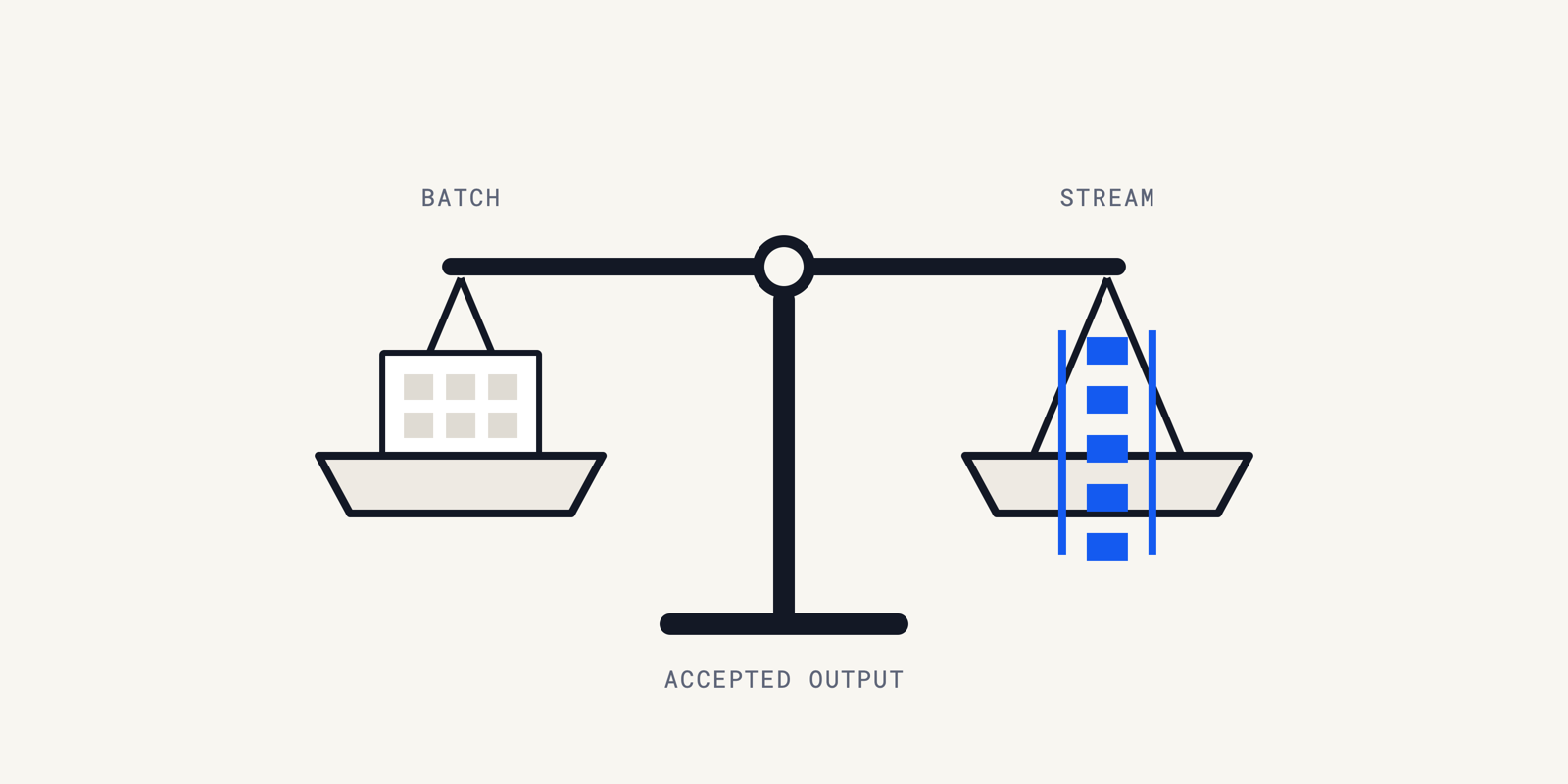
Choose batch or stream processing by the result the operation must release and the evidence needed to trust it. Batch jobs need a defined input scope and accepted output. Streaming needs progress, lateness and correction rules. Both need safe recovery and named owners. Compare the actual workload, then document which output version downstream teams may use. A running process or successful restart cannot settle that decision alone.
We use batch processing to run a defined set of work automatically, without someone directing each record. Workflow monitoring must explain its result.
A green job can leave an operations team asking which version of this report we can use. A live feed can create the same uncertainty when older events arrive after a decision.
We would settle that question before choosing an engine. The person approving an operational result needs evidence they can inspect, not a label describing the processing style.
We'll compare the models, separate the relevant clocks, and build a record for corrections and recovery.
Choose the Processing Model by the Result You Must Release
We choose batch processing or stream processing from the required output and its acceptance rules. A latency label alone does not explain what the operation can safely use.
1. Start With the Boundary of the Work
We first ask what belongs in the result. Is it a defined collection that can close, or an ongoing sequence whose useful answer changes as events arrive?
Databricks distinguishes processing semantics from execution cadence. Its documentation includes streaming workloads that run on a schedule, so we would not classify a system from its schedule alone.
We would write the source boundary beside the proposed model. Record the input selection, relevant partition or interval, and the rule for admitting records that arrive after that boundary.
That small description prevents a broad comparison from hiding a different requirement. A team may need a regularly released result even when the underlying calculation updates incrementally.
We use this table as a decision test, not a claim that every engine implements each feature identically.
| Decision | Batch Processing | Stream Processing |
|---|---|---|
| Work boundary | Identify the selected input for a run | Identify the ongoing input and the progress position |
| Result release | Accept a named output from the selected work | Define when an updated result becomes usable |
| Late input | Decide which completed scope needs correction | Define how late events affect retained state and emitted results |
| Recovery evidence | Match repeated work to its accepted output | Match restored state and replay to downstream effects |
| Operational ownership | Assign the person accepting a run or correction | Assign the person accepting changing results and exceptions |
We would choose the first column when a bounded release meets the business requirement and the team can prove its completeness. We would consider the second when useful updates must arrive before that release boundary.
If neither choice has an acceptance rule, the architecture decision is premature. We would ask the result's consumer to state the decision it supports and what makes that result unusable.
2. Describe Output Acceptance Before Comparing Engines
We want a statement that an operator can test. The result covers the agreed source scope, carries an identifiable version, and reaches the destination that uses it.
A processing model cannot supply that statement on its own. We would document any gap between the engine's output and the business process consuming it.
For batch processing, we would name the output artifact or dataset version produced by the run. For streaming, we would name the emitted result and the policy governing later revisions.
| Acceptance Question | Evidence We Would Request |
|---|---|
| What work does this result represent? | Input selection or progress boundary |
| Which result is authoritative? | Output identifier and accepted version |
| Can that result change? | Correction policy and approval owner |
| Who has already used it? | Downstream destination and consumption evidence |
| What would make us withdraw it? | Explicit failure or invalidation condition |
These are our proposed review fields, not a vendor certification. An unanswered field is a requirement to resolve, rather than a reason to fill in a convenient assumption.
Micro-batch processing also belongs in this discussion. Spark Structured Streaming normally executes using micro-batches. A small batch inside an engine does not remove the need to govern an ongoing result.
We would ask the engineer to describe the deployed mode, connectors and output behavior. Naming Spark, Flink or a managed service is not enough to establish the actual contract.
3. Compare Cost Against the Same Accepted Result
We would compare the cost of producing the same usable output, including correction and recovery work. Comparing two different freshness requirements produces a misleading answer.
Our evaluation would include infrastructure, retained state, storage, engineering time and the operator's work when a result needs correction. We would record actual measurements from the proposed workload.
We would also separate a steady run from a recovery run. A design that is affordable while current may need a different capacity plan when historical work catches up.
We would not assign a universal cost winner to batch vs stream processing. The useful decision is narrower. We ask which design meets this operation's acceptance rule with a burden the team can support.
Pro tip: We would ask the downstream owner to sign off on the acceptance fields before reviewing a benchmark. Otherwise, a faster result may simply answer a different question.
Give Workflow Monitoring Separate Clocks for Work and Data
We separate when batch processing runs from the period its output represents. Stream processing also needs a distinction between event occurrence and processing progress.
1. Keep the Data Interval Separate From Execution
Airflow's DAG-run documentation distinguishes a data interval from the logical date and actual execution. We would preserve those meanings in the operations view.
A delayed run should not quietly change which period the team thinks it covers. We would display the selected interval beside the run's start, completion and output reference.
Airflow also warns that a successful leaf task using an all_done trigger rule can leave a DAG run successful despite an upstream failure. We would inspect the deployed task graph before interpreting its final status.
| Record | Question It Answers |
|---|---|
| Data interval | Which period was selected for processing? |
| Execution timestamps | When did this attempt actually run? |
| Output identity | Which result did this attempt produce? |
| Acceptance state | Has the responsible owner accepted that result? |
We would keep these fields visible together. Collapsing them into a single green indicator removes the distinction an operator needs when a customer asks about an older period.
2. Make Event Time and Watermarks Understandable
Flink describes event time as the time an event occurred, and processing time as the machine's time while executing an operation. We would name the chosen timestamp in the runbook.
Watermarks express progress through event time under the configured policy. We would not describe a watermark as proof that every possible older event has arrived.
Flink's documentation explains that operators with multiple inputs use the minimum incoming watermark. We would therefore ask which input controls progress before declaring the whole workflow healthy.
For batch processing and streaming alike, we want the dashboard to distinguish an observed value from a policy assumption. An operator should see when the evidence is missing.
For broker-backed systems, we would keep Kafka consumer lag diagnosis as a separate investigation. A lag measurement does not itself identify the accepted business output.
This is where workflow monitoring should help an operations team connect records and explain where work stopped. We would preserve the evidence needed for a human to decide the next action.
Make Late Corrections a Named Operational Decision
We assign responsibility for accepting a correction before late data changes a result. Batch processing and stream processing both need a clear answer to who can approve the revised output.
1. Separate Recovered Input From Refreshed Results
TigerData's October 21, 2026 cut-uplink guide uses synthetic sensor data to demonstrate reconnect and backfill behavior. We treat it as a reproducible example, not a customer incident.
The guide separates durable raw ingest from aggregate refresh. Its example requires a scoped refresh for older backfilled data outside the rolling refresh policy.
That distinction matters to our architecture review. Restoring the input alone does not establish that the result being read downstream reflects the restored records.
We would ask the implementation owner to show two pieces of evidence, the recovered source scope and the corresponding refreshed output. We would also record which derived results remain outside the recovery.
A successful replay can be useful evidence without being the final acceptance decision. We would resist closing the operational issue until the relevant consumer has the result they need.
2. Give Each Correction an Output Version and Owner
We would require a correction record that links the affected input to the revised result. This is our recommended review method, rather than a claim about a specific engine's built-in features.
| Correction Field | What We Would Record |
|---|---|
| Affected scope | Source interval, partition or event range |
| Reason | Late input, corrected source data or computation defect |
| Previous output | The version already released |
| Replacement output | The version proposed for acceptance |
| Authority | The person responsible for approving the correction |
| Consumer impact | Where the earlier version has already been used |
We would ask the owner to decide how recipients learn that an accepted number changed. Replacing a dataset silently may leave a downstream report using an earlier version without explaining the disagreement.
The required process can be modest. We prefer a clear, inspectable record to an elaborate approval flow that nobody uses during an incident.
We would still retain the original evidence. An accepted correction should explain what changed, rather than erase the basis of the earlier operational decision.
Pro tip: We would record the previous and proposed output identifiers before approving a correction. A note saying “backfill complete” cannot identify which result recipients should now use.
Approve Recovery Only After Checking the Consumed Output
We approve recovery when the output consumed by the operation satisfies its acceptance rule. Restarting batch processing or restoring a streaming job is an intermediate technical event.
1. Check the Scope of the Delivery Guarantee
Flink's fault-tolerance documentation distinguishes exactly-once effects on managed state from end-to-end behavior. The latter requires replayable sources and transactional or idempotent sinks.
We would inspect that boundary before repeating a guarantee in an operations runbook. Checkpointing can restore processing state; it does not establish every external action's behavior by itself.
For batch processing, Airflow's task guidance recommends repeatable outcomes and partition-specific reads and writes. We would check idempotency at the actual destination, including any effect beyond the task's local state.
We would have the engineer identify the source position, checkpoint or run attempt, and destination behavior that support the claimed recovery. Unknown behavior remains an open question.
2. Keep a Recovery Acceptance Record
We would use a small evidence record during a controlled recovery exercise. It connects the technical recovery to the operational result without prescribing an unsafe production replay.
- Identify the affected input scope and the last accepted output.
- Record the restart or replay method and the person authorizing it.
- Inspect the resulting destination records or artifact.
- Check the agreed duplicate, missing-record and correction conditions.
- Record the accepted output version and the owner approving its use.
We would test the actual failure and recovery paths in an appropriate environment before relying on this record during an incident. A clean normal run does not exercise those paths.
The older guide to independent expectations for silent failures explains the separate question of detecting absent work. Our acceptance record addresses which recovered result the team may use.
We would keep a failed exercise as evidence for the architecture decision. If the team cannot identify the restored output or its effects, we would resolve that gap before approving the design.
Write the Acceptance Record Before Choosing the Engine
We would choose one workflow and write four fields before comparing implementations. The record needs the input boundary, release rule, correction owner and recovery evidence. That makes batch processing a concrete operating choice.
We would then test the proposed model against the result the downstream team actually consumes. Workflow monitoring should make a disagreement explainable, including the version that remains unaccepted.
For connected production investigations, we would use Operate to gather evidence and propose next steps for human review, while keeping operational approval with the responsible team.
Frequently Asked Questions
Yes. We would look at IBM's batch guide, which covers batch jobs and how to update them. We would judge batch processing by the real job it must do now and its platform support, not the age of the design.
We use payroll as a familiar example. A system processes a collection of payroll transactions together. IBM identifies payroll among batch-processing uses. We would keep the computation separate from any authorization to distribute money because describing a processing method does not grant that authority.
We would estimate duration from representative runs of the actual job, including input size, resource limits and competing work. We would measure startup separately from processing and inspect variation across runs. There is no duration we would promise from the term batch processing alone.
Yes. We would use Spark's batch DataFrame and SQL capabilities when they fit the job. The Databricks documentation describes batch and streaming semantics in Spark workloads. We would check the selected API and execution mode directly instead of inferring them from the Spark product name.
We would check which API the app uses. Spark calls the old DStreams engine a legacy project that no longer gets updates and points users to Structured Streaming. We would not read that as an end to all Spark streaming jobs.
About the author

Operate Team
The team behind Operate
Operate Team builds Operate, enterprise AI agents for production operations. Operate answers production questions from Slack and Microsoft Teams, investigates alerts, and reviews performance, security and cost. It finds the root cause with evidence and proposes a fix for an engineer to review, with controlled access to your systems.