Did Your AI SRE Query a Caught-Up Replica Before Finding No Order?
Test if an AI SRE mistakes an empty replica read for a failed write. Use seven evidence cards covering replay, snapshots, query errors and uncertainty.
Quick Answer
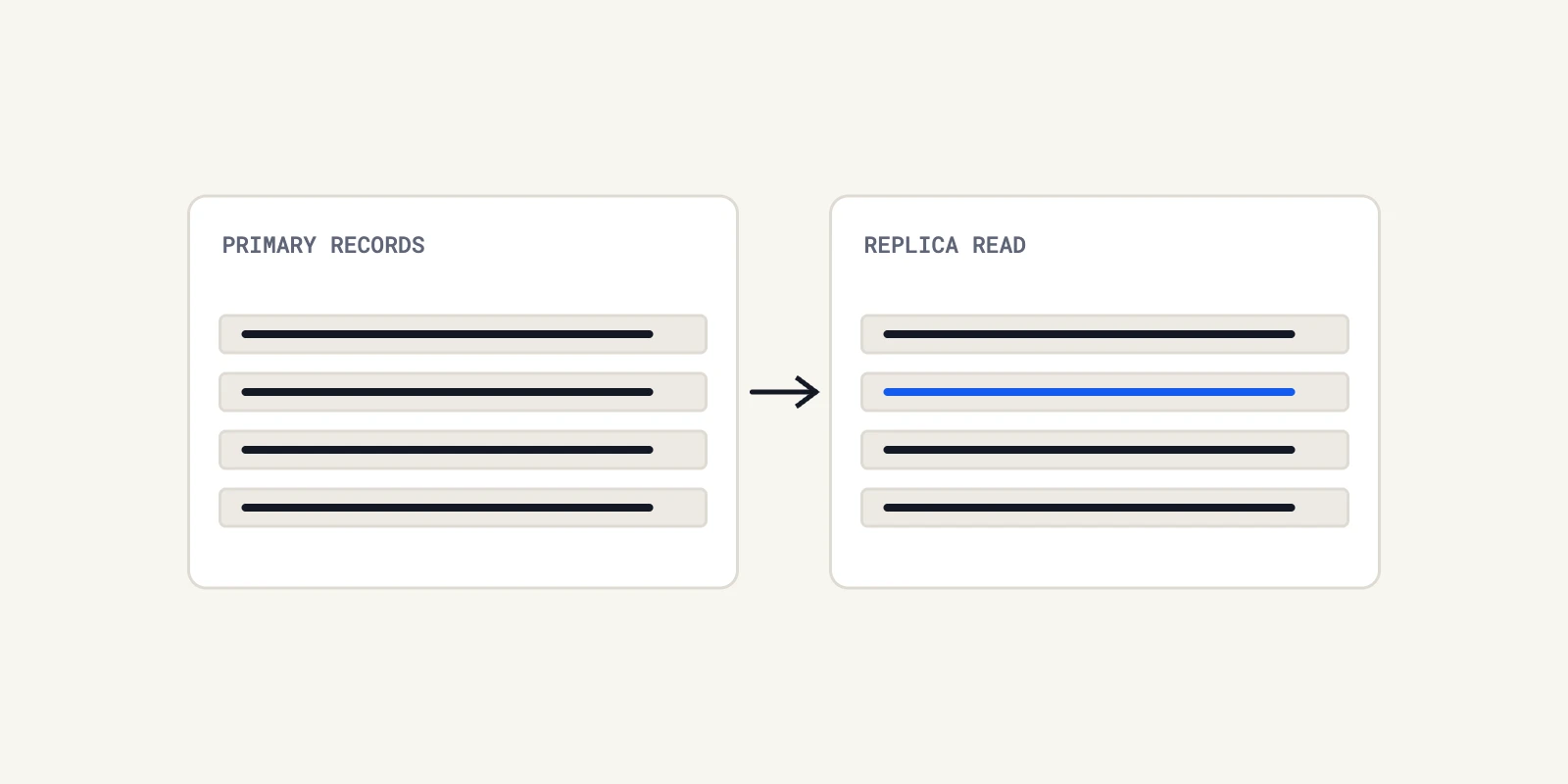
An AI SRE read replica investigation should not treat zero rows as proof that a write failed. PostgreSQL standby reads can be stale, a Repeatable Read snapshot can be old, and a failed query can be hidden by tooling. The safer acceptance test records endpoint identity, tenant scope, query status, snapshot timing, replay evidence, commit-marker provenance and the exact result, then returns a supported finding or abstains.
By AI SRE read replica investigation, I mean a production investigation where an AI system reads a PostgreSQL replica to answer a support question about a customer record. I care about one narrow moment. A customer says an order saved, the tool queries a database, and the answer comes back with zero rows.
That result feels clean. I do not think it is clean enough to blame the application, reject the customer report, or escalate as a failed write. A replica read can answer a different question from the one support asked.
This post gives a bounded acceptance test for that support answer. I will separate successful-empty, successful-found and failed-read states, then use seven synthetic evidence cards to decide when the right answer is a finding and when the right answer is insufficient evidence.
A Zero-Row Read in an AI SRE Read Replica Investigation Is Not a Failed-Write Verdict
A zero-row result in an AI SRE read replica investigation establishes only that one scoped query returned no rows from one database view. I would not let that result become “the write failed” unless the tool proves the endpoint, replay state, snapshot timing and query status.
The support complaint is simple. A customer reports a saved order. The investigation tool checks the orders table and finds nothing for the supplied tenant and key. That can mean the order was never written, but it can also mean the read looked at the wrong place, the wrong time, or no useful result at all.
I keep three states separate. A successful-empty read is a real observation. A successful-found read can support a positive finding. A failed-read state cannot support either one, even when the wrapper prints an empty array.
PostgreSQL makes this distinction concrete. The PostgreSQL 18 Hot Standby documentation says a physical standby can return a different result, replayed commits become visible to new snapshots after replay, and recovery conflicts can cancel reads. That is enough to make “zero rows” a starting point, not a verdict.
Supabase states the buyer-facing version of the same risk. Its read replica guide says high replication lag can yield stale query results, and it does not give a universal lag threshold that makes every business read safe.
Pro tip: I would make the tool show successful-empty, successful-found and failed-read as separate result classes in the support UI. If they share one empty wrapper, reviewers lose the most important distinction.
PostgreSQL Physical Standby Reads Set the Boundary for an AI SRE Read Replica Investigation
An AI SRE read replica investigation stays bounded when it treats PostgreSQL physical standby reads as evidence with limits. I would scope the test to physical standby behavior, not every possible cache, queue or application routing design.
A delayed replica can miss a commit that exists on the primary. An older query snapshot can miss a row that a new snapshot would see. A failed query can return no useful evidence after a timeout, cancellation or permission error.
The minimum PostgreSQL distinction is receive versus replay. The PostgreSQL 18 Recovery Information Functions documentation describes receive and replay LSNs as different stages. Receiving WAL does not mean every relevant commit is visible to the query snapshot.
Snapshot lifetime matters too. The PostgreSQL 18 Transaction Isolation documentation explains that Read Committed and Repeatable Read use different snapshot lifetimes. A fresh server state does not refresh an established Repeatable Read snapshot.
I would also be careful with last replayed transaction time. The PostgreSQL recovery functions documentation says the last replayed transaction timestamp has documented conditions for NULL, and it is not a universal freshness bound. On an idle source, that timestamp can look old while supplied positions are current.
Three comparisons are especially dangerous. I would not compare LSN strings from unrelated clusters. I would not compare positions across divergent timelines. I would not call a pre-commit cursor a commit receipt.
AE Digital Agency already covers missing orders, write watermarks, replay, routing limits and application journey tests in its ecommerce read replicas guide. I am not treating those mechanisms as new. I am narrowing the buyer test to support-answer acceptance.
AI SRE Read Replica Investigation Needs an Evidence Receipt Before It Blames the Write
An AI SRE read replica investigation should produce an evidence receipt before it claims a customer write failed. I want the receipt to preserve unknown fields instead of filling them with confidence.
The receipt is not a dashboard. It is the minimum packet a reviewer needs to decide what the answer can support. A timestamp alone cannot certify visibility, because it does not prove endpoint identity, replay, snapshot age or commit relevance.
• Actual Endpoint and Cluster Lineage
I want the receipt to name the actual read endpoint and its cluster lineage. “Replica” is not enough. The tool needs to show which server answered, which cluster it belongs to, and why that endpoint is related to the customer write path.
If the query used freshness metadata from one replica and data from another, I would mark the answer unsupported. That mismatch appears in one of the synthetic cards because it is easy to hide behind a clean empty result.
• Database, Schema and Authorized Tenant Scope
The receipt should show the database, schema and tenant or key scope that the tool was authorized to query. A support answer about tenant acme does not become stronger because the tool searched a broader place later.
I would not silently escalate database permissions to make the answer look complete. A scoped absence observation is useful only inside the scope that was actually allowed and executed.
• Query Status and Raw Error Preservation
The receipt should show if the query succeeded, failed, timed out or was canceled. The PostgreSQL 18 Hot Standby documentation specifically notes that recovery conflicts can cancel reads, which means cancellation must not disappear inside an empty response.
For Operate, I would start with the current deployment guide, which recommends a replica or read-only database user. I would still test if raw query errors, endpoint identity and snapshot context appear in the evidence packet before I accepted a support answer.
• Query Timing, Snapshot Timing and Isolation
The receipt should record query timing, snapshot timing and isolation level. Repeatable Read can keep an older view even after the standby catches up, while Read Committed can take a new snapshot per statement under the documented rules.
I care about this because “server was fresh” and “this query snapshot was fresh enough” are different claims. An AI SRE read replica investigation can get the first one right and still answer from an old transaction.
• Replay Evidence and Supplied Commit-Marker Provenance
The receipt should show replay evidence and explain any supplied commit marker. If the marker came from the application after commit, it can help. If it came from a cursor opened before commit, it cannot prove visibility.
I would write the provenance field in plain language. “Client supplied cursor” is different from “commit marker from the write transaction.” Unknown remains unknown.
• Exact Result and Supported Conclusion
The receipt should preserve the exact result. That includes zero rows, one found row, canceled read, permission failure or tool parsing error. I would not let the final answer compress these into “not found.”
The supported conclusion then uses one of three forms. It can state a supported positive finding. It can state a scoped absence observation. It can abstain because the evidence does not support either answer.
Seven Synthetic Cards Test an AI SRE Read Replica Investigation Against Replica Ambiguity
These seven synthetic cards test whether an AI SRE read replica investigation can distinguish evidence from guesswork. None of these cards was run against a vendor or a database in this research, so I treat them as review prompts, not benchmark results.
1. Card A Has Received WAL but No Replay
The evidence says the standby received WAL that may contain the order commit, but replay has not reached that point. The scoped order query returns zero rows.
My human answer is insufficient evidence. The tool may report the zero-row observation, but it cannot say the customer write failed because replay has not proved visibility to a new snapshot.
2. Card B Has a Caught-Up Server and an Old Repeatable Read Snapshot
The evidence says the server is now caught up, but the query runs inside an older Repeatable Read snapshot. The order query returns zero rows from that existing transaction view.
My human answer is insufficient evidence for a failed write. The server state may be current, but the snapshot is older than the visibility question.
3. Card C Uses a New Snapshot That Finds the Order
The evidence says replay has passed the relevant commit marker and a new snapshot runs the scoped query. The exact result contains the reported order.
My human answer is a supported positive finding. The investigation can say it found the order in the authorized scope, and it can cite endpoint, replay, snapshot and result evidence.
4. Card D Has an Idle Source With an Old Last-Transaction Time
The evidence shows an old last replayed transaction timestamp, but current supplied positions on an idle source. The scoped query result depends on those positions and the snapshot, not the age of the last transaction time alone.
My human answer is to avoid a stale-replica claim based only on that timestamp. The PostgreSQL recovery functions documentation makes that timestamp conditional, so I would ask for replay position and snapshot evidence.
5. Card E Hides Cancellation Inside an Empty Wrapper
The evidence contains a recovery conflict cancellation, but the tool wrapper presents an empty result. The exact SQL status is not a successful-empty read.
My human answer is failed read. I would reject any conclusion that says the order was absent, because the database did not provide a successful scoped result.
6. Card F Mixes Freshness Metadata From a Different Replica
The evidence gives freshness metadata from one replica and query output from another. The query output is zero rows, but the freshness proof does not belong to the endpoint that answered.
My human answer is insufficient evidence. Endpoint provenance breaks the chain, so the tool cannot use one replica’s replay state to certify another replica’s read.
7. Card G Shows a Fresh Scoped Empty Result Without Write History
The evidence shows the actual endpoint, authorized tenant scope, successful query status, fresh snapshot and replay state. The exact result is zero rows, but no write history is available.
My human answer is a scoped absence observation. I would allow “no matching row was visible in this scoped fresh read.” I would not allow “the record never existed,” because write history is missing.
A Decision Worksheet Keeps an AI SRE Read Replica Investigation From Overclaiming
A decision worksheet keeps an AI SRE read replica investigation honest by forcing the answer to pass through evidence gates. I use it to choose between a supported positive finding, a scoped absence observation and insufficient evidence.
1. Identify the Source and Scope
I first ask if the actual source is known and related to the write path. Then I ask if the database, schema and tenant or key scope match the support complaint.
If either answer is unknown, I do not let the tool blame the write. The most I would accept is an observation about the endpoint and scope that were actually queried.
2. Confirm the Query Succeeded
I next ask if the SQL query succeeded. A canceled read, timeout, permission failure or parsing failure cannot become an empty result.
This is where I expect tools to lose evidence. Empty JSON is convenient, but it can erase the difference between “no row matched” and “no reliable read happened.”
3. Verify the Commit Marker Is Relevant
I then ask where the supplied commit marker came from. A marker tied to the committed write is useful. A pre-commit cursor, unrelated LSN or timestamp without provenance is not enough.
The worksheet should make this field explicit. Unknown provenance should stay unknown, even when the support case has pressure to close.
4. Prove the Snapshot Follows Replay
I finally ask if the query snapshot follows replay of the relevant commit. This gate catches both delayed replicas and older Repeatable Read snapshots.
If the answer is yes and the result is found, I accept a positive finding. If the answer is yes and the result is empty inside the authorized scope, I accept a scoped absence observation. If the answer is no or unknown, I abstain.
Compare AI SRE Read Replica Investigation Answers Across Workflows Without Inventing a Pass Rate
I would compare AI SRE read replica investigation answers across a human engineer, shortlisted software and a provider-assisted workflow, but I would leave results blank until the review actually runs. No synthetic pass rate proves production safety or customer savings.
The comparison should judge behavior, not branding. I care about unsupported claims, correct uncertainty, evidence citations and reviewer correction time.
| Review Item | Human Engineer | Shortlisted Software | Provider-Assisted Workflow |
|---|---|---|---|
| Unsupported failed-write claim | Blank until performed | Blank until performed | Blank until performed |
| Correct insufficient-evidence answer | Blank until performed | Blank until performed | Blank until performed |
| Endpoint and snapshot cited | Blank until performed | Blank until performed | Blank until performed |
| Raw error preserved | Blank until performed | Blank until performed | Blank until performed |
| Reviewer correction time | Blank until performed | Blank until performed | Blank until performed |
I would run the same seven cards through each workflow and record the first answer before coaching. If a reviewer has to ask for endpoint identity, replay evidence or raw SQL status, that correction belongs in the scorecard.
This comparison also prevents a common buying mistake. A polished answer that says “order not found” can look better than a cautious answer that says “insufficient evidence.” For this support question, the cautious answer may be the only supported one.
Run the Worksheet Before You Reject the Customer Report
An AI SRE read replica investigation should protect the customer report from an overconfident empty read. I would require endpoint identity, authorized scope, query status, snapshot timing, replay evidence, commit-marker provenance and the exact result before I accepted a failed-write conclusion.
The practical next step is small. Take the seven cards, add them to your evaluation packet, and score every tool or workflow on evidence preservation and abstention. Do not reward retries that hide errors, permission escalation that changes scope, or timestamps that pretend to prove visibility.
If you evaluate Operate, apply the same worksheet to it, a manual workflow and any alternative. Operate is a self-hosted AI SRE that reads logs, database and code, drafts a patch for engineer review, runs read-only with logged queries, and cannot commit, open pull requests, merge or deploy.
Frequently Asked Questions
Yes. In an AI SRE read replica investigation, I assume a read replica can lag until evidence proves otherwise. A customer-facing timestamp or a recent connection does not prove replay. I want the actual endpoint, replay position and query snapshot before I trust absence.
No. In an AI SRE read replica investigation, I treat an empty SQL result as one scoped observation. It may support “not visible in this read.” It does not prove the row never existed, was never committed, or was absent from every valid write path.
In an AI SRE read replica investigation, I separate WAL the standby has received from WAL it has replayed. Received WAL may sit ahead of visible database state. Replayed WAL is the stage that matters for a new snapshot reading committed changes on the standby.
Yes. In an AI SRE read replica investigation, I would check the transaction isolation level before trusting a zero-row answer. A Repeatable Read transaction can keep an older snapshot, so a committed row may remain invisible until a new transaction or snapshot is used.
When freshness is unknown, an AI SRE read replica investigation should abstain from a failed-write claim. I would expect the answer to name the missing evidence, preserve the exact query status, and state only the scoped observation that the tool can support.
About the author

Operate Team
The team behind Operate
Operate Team builds Operate, enterprise AI agents for production operations. Operate answers production questions from Slack and Microsoft Teams, investigates alerts, and reviews performance, security and cost. It finds the root cause with evidence and proposes a fix for an engineer to review, with controlled access to your systems.