What Does AI SRE Data Retention Cover After Deleting an Investigation?
Evaluate AI SRE data retention with a worksheet for threads, derived memory, exports and backups. Verify deletion scope without mistaking silence for erasure.
Quick Answer
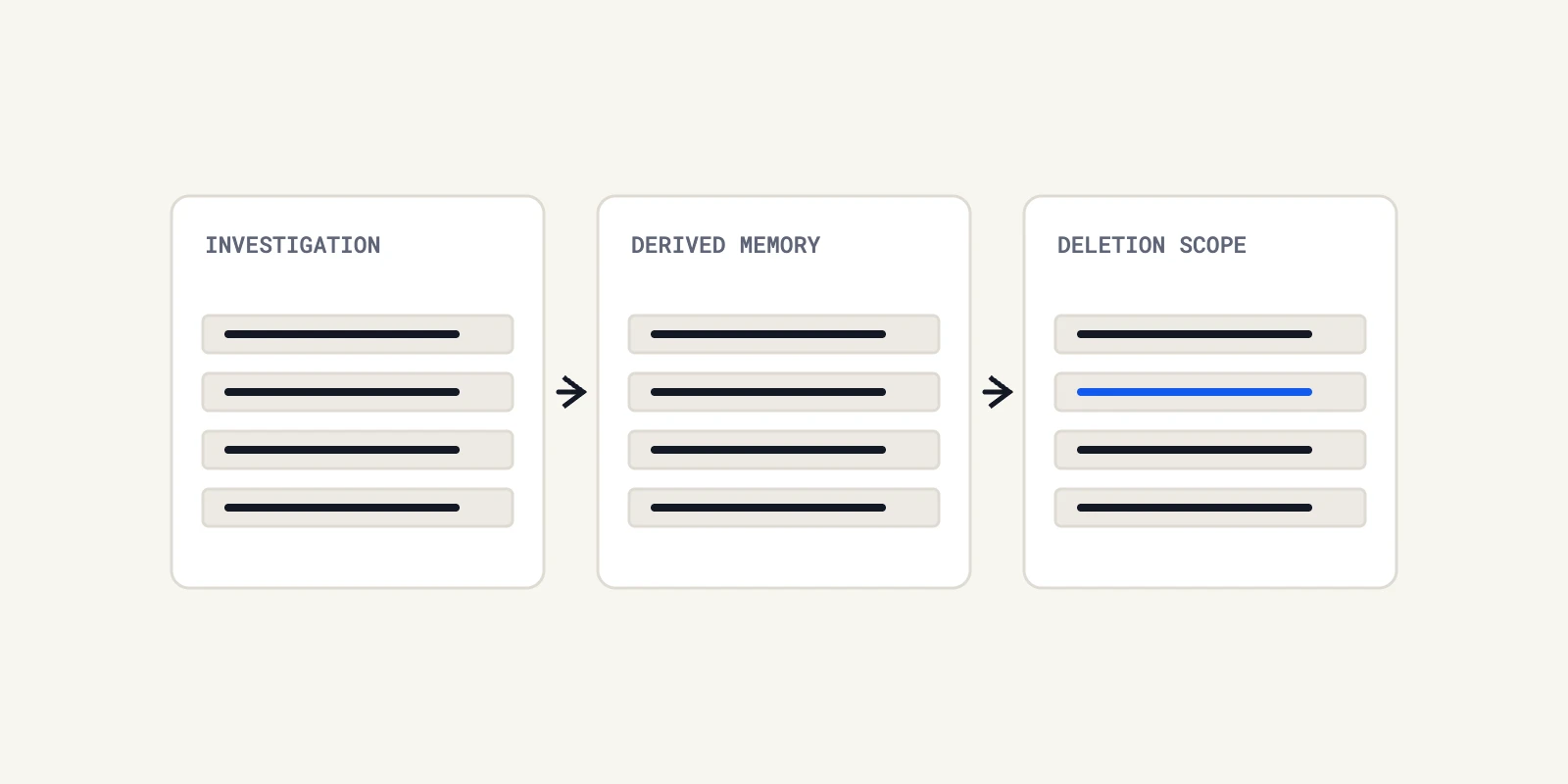
AI SRE data retention after deletion depends on the artifact, not just the visible investigation thread. A buyer should inventory source evidence, copied excerpts, derived insights, user memories, retrieval indexes, traces, reports, exports and backups. Deletion evidence needs a scoped completion record, a fresh-session check, a retained positive control and explicit residual-copy expiry. Model non-recall does not prove stored records were erased.
I use AI SRE data retention to mean the set of stored records an AI SRE creates or keeps while investigating production, plus the rules for how those records expire or get deleted. The hard part is that an investigation is not one object.
A Slack answer can look gone while an extracted log line, a session insight or an exported report still exists in another store. I would not treat that as a legal compliance question in this post. I would treat it as a procurement and pilot-design question for a US B2B SaaS team evaluating production-investigation software.
The practical question is narrow. If you delete an investigation, what did the product promise to delete, who owns each store and what evidence proves completion. I will map the artifact path, show documented vendor examples, give a deletion-evidence worksheet and apply the same checks to a self-hosted AI SRE evaluation.
AI SRE Data Retention Starts With More Than the Deleted Thread
AI SRE data retention starts with the fact that deleting the visible investigation is only one operation. I would ask for a store-by-store inventory before I let a pilot use production incidents as test material.
For the audience I have in mind, roughly 15–75 engineers, the risk is not abstract. A support escalation may begin in Slack or MS Teams, but the AI SRE may read logs, database state and code context before it drafts an explanation. The visible thread is only the user-facing artifact.
I would separate the source system from the AI SRE copy. A database row in production is source evidence. A serialized tool message containing a query result excerpt is a copied artifact. A user memory or persistent session insight is a derived artifact. Those stores deserve different deletion claims.
Procurement often asks a simple question, and I think the better version is more precise. Do not ask only, did the investigation delete. Ask which artifacts were in scope, which artifacts were out of scope and which residual copies expire later.
A deletion acknowledgment is not enough for AI SRE data retention review. I want a named owner, a request timestamp, a deadline and evidence that each promised store changed state. I also want a retained positive control, because a test that deletes too much can hide an access or indexing bug.
Pro tip: Keep one unrelated investigation or memory as a retained control during deletion testing. If the control disappears, the test found collateral deletion, not proof of correct cleanup.
AI SRE Data Retention Follows an Artifact Path From Evidence to Memory
AI SRE data retention follows an artifact path from source evidence to copied excerpts and then to derived knowledge. I would draw that path before running a deletion test, because every branch changes what the test can prove.
A basic path looks like this.
- Source evidence in logs, databases, metrics, code and incident systems
- Thread content, including user prompts and assistant answers
- Tool excerpts, including serialized messages with result snippets
- Insights, user memories and synthesized knowledge
- Search retrieval stores that later surface those insights
- Traces, telemetry, reports, exports and backups
The source evidence branch matters because deletion from the AI SRE should not mean deleting production logs or database rows. The copied-excerpt branch matters because an answer can contain a fragment that outlives the full query. The memory branch matters because derived facts can survive after a conversation goes away.
Provider inference retention is a separate boundary. If a configured external model provider receives investigation context, the buyer needs to read that provider’s retention terms. If the team uses a self-hosted model inside its network, that boundary changes. I would never convert either setup into a blanket claim that data never leaves the customer environment.
Model-weight unlearning is also a separate boundary. A stored record deletion test does not prove that a model can or cannot recall something from weights. In this review, I would test application stores, retrieval stores, traces, reports and backups. I would not treat model silence as evidence of storage erasure.
The most common mistake I see in this question is treating search failure as deletion. A fresh session that cannot find the old answer is useful evidence, but it is only one field in the worksheet. It does not inspect backups, exported copies or opaque telemetry retention.
AI SRE Data Retention Examples Show Different Lifecycle Boundaries
AI SRE data retention examples in public docs show why thread deletion, memory deletion, report expiry and telemetry retention need separate rows. I would not rank vendors from these docs, because the sources describe documented scope, not tested behavior.
| Example | Documented Boundary | Why I Would Put It in the Worksheet |
|---|---|---|
| Microsoft Azure SRE Agent | Conversation threads, session insights, memory files and thread files have distinct storage and retention descriptions in the security overview | Thread removal cannot be assumed to erase every other store |
| Microsoft Azure SRE Agent | The data-storage table distinguishes thread and agent deletion, document removal, user-memory removal, session insights retained until agent deletion and separately configured Application Insights retention on a page that displays Sep 29, 2026 in the data privacy reference | A deletion test needs rows for memory, session insights and telemetry |
| AWS CloudWatch investigations | Investigation-group retention is 7–90 days starting at closure, automatic closure occurs after seven days if not manually ended, unconfigured session investigations expire after 24 hours and reports follow parent retention in the CloudWatch retention page | Closure time and exported reports need their own inventory |
| Corelayer guide | The guide dated September 11, 2026 by Mitch Radhuber covers inference, zero retention, masking and audit questions in a secure AI SRE guide | A questionnaire helps, but I still want deletion evidence |
• Microsoft Stores Threads, Memories, Insights and Telemetry Separately
Microsoft’s docs are useful because they split lifecycle terms instead of hiding them behind one retention sentence. The Azure SRE Agent memory page describes automatic insight indexing after a quiet interval, proactive persistent knowledge files and discrete user memories with separate commands.
I read that as a reason to test asynchronous work. If an investigation ends, a later indexing job may still create or update derived stores. That does not prove a deletion failure by itself, but it does create a store that needs a declared owner and deletion rule.
The Azure SRE Agent threads page documents thread deletion as permanent removal of the thread and also documents distinct memory commands. I would never infer from that pair that deleting a thread deletes every memory, session insight or telemetry record.
• AWS CloudWatch Investigations Start Retention at Closure
AWS CloudWatch investigations show a different lifecycle shape. The retention clock starts at closure, and reports follow the parent retention in the CloudWatch retention page.
That means the deletion worksheet needs closure state and report state. If a report was exported, I would add an owner for the exported copy. I would not transfer these CloudWatch defaults to AWS DevOps Agent, because that source only covers CloudWatch investigations.
• Vendor Security Guides Can Ask the Right Questions Without Proving Deletion
A security guide can ask the right questions without proving the product behavior. Corelayer’s September 11, 2026 guide by Mitch Radhuber is a vendor statement, not an independent deletion benchmark.
I still like using those questions during procurement. They force the team to ask about inference, masking, zero retention and audit trails. For AI SRE data retention, I would add one extra demand. Show the deletion evidence by artifact, not by policy sentence.
AI SRE Data Retention Needs a Deletion Evidence Worksheet
AI SRE data retention needs a deletion evidence worksheet because storage erasure is a scoped claim. I would use one ledger row per artifact and mark unsupported visibility as unknown instead of filling gaps with optimism.
The worksheet should capture what the product promised and what the reviewer observed. It should not ask the model to grade itself. A model saying it forgot is a useful fresh-session result, but it is not enough evidence for active-store erasure.
| Field | What I Would Record | Example of a Useful Entry |
|---|---|---|
| Artifact ID | A stable identifier for the thing being tested | Thread T-17 or insight I-42 |
| Artifact Type | The store category | Thread, tool excerpt, user memory, session insight, report, trace, export or backup |
| Lineage | The source evidence and derived stores connected to it | Log excerpt copied from checkout-API on the incident date |
| Owner | The team or system that can answer for the store | Product admin, observability owner, model-provider owner or backup owner |
| Scope Promised | The exact deletion promise | Active thread removed, user memory removed or backup expires by declared policy |
| Request Timestamp | When deletion was requested | Use the system timestamp, not a screenshot time |
| Deadline | When completion was promised | Vendor SLA or pilot acceptance deadline |
| Completion Evidence | The proof that the in-scope store changed | Admin event, audit event, API response or storage query |
| Fresh-Session Result | What a new authorized session can retrieve | Cannot retrieve deleted thread by known title |
| Retained Positive Control | An unrelated artifact expected to remain | Thread C-02 still retrievable |
| Residual-Copy Expiry | Declared expiry for backups, reports or exports | Backup expires under declared lifecycle |
| Observed Result | Reviewer finding | Pass, fail, pending or inconclusive |
I would make the reviewer write pass, fail, pending or inconclusive in the observed-result field. Pending is not failure if the deadline has not arrived. Inconclusive is not pass if the product does not expose the store.
The retained positive control is the field most deletion tests skip. If a test removes the target and also removes an unrelated memory, the product may have broad cleanup behavior. That can be desirable in a reset command, but it is not scoped deletion evidence.
The residual-copy expiry field also prevents overclaiming. If active records disappear but backups remain for a declared lifecycle, the finding can still pass against the promised scope. It cannot become a claim of all-data erasure.
This same worksheet belongs in security review for self-hosted deployments. For an AI SRE that runs in your infrastructure, I would start with the vendor’s public data-flow claims and then ask the implementation owner to prove each artifact row. Operate’s public security page says investigation processing is self-hosted, external-provider context transfer occurs when configured, billing usage records are separate and audit retention is configurable.
AI SRE Data Retention Reviewer Cards for Scoped Deletion Testing
AI SRE data retention reviewer cards make the worksheet concrete. I would use synthetic cases like these during a pilot, and I would label them as proposed tests rather than measured vendor failures.
Each card keeps the answer key separate from observed results. That matters because a buyer should not start with the desired answer. The reviewer should fill the artifact IDs, evidence fields and fresh-session result from the actual pilot environment.
1. D1 Observed Active-Copy Completion
Scenario D1 tests a clean active-copy deletion. The target thread and the in-scope tool excerpt disappear from supported active stores, the fresh session cannot retrieve them and the retained positive control remains.
Answer key is pass for the promised active-copy scope. I would still leave backup expiry and exported reports as separate fields, because D1 does not prove anything about stores outside the declared scope.
2. D2 Thread Gone but an In-Scope Insight Retained
Scenario D2 catches the mistake behind many AI SRE data retention claims. The visible thread is gone, but a derived session insight or user memory that was promised in scope still retrieves the same investigation fact.
Answer key is fail for the promised scope. I would record the lineage from the deleted thread to the retained insight, because the failure is not just recall. It is an in-scope derived store still containing the artifact.
3. D3 Accepted Request Before Deadline
Scenario D3 avoids calling an unfinished request a failure. The deletion request is accepted, the deadline has not arrived and the active artifact still exists.
Answer key is pending. I would record the request timestamp, the promised deadline and the owner. If the deadline passes without completion evidence, the row can move from pending to fail or inconclusive based on store visibility.
4. D4 Later Extraction or Source Reimport
Scenario D4 tests recreation. The original artifact is deleted, but a later authorized job reads the source logs or database again and creates a new excerpt or insight.
Answer key depends on the promise. If the promise covered future recreation from source lineage, this may fail. If the promise covered only stored records created before deletion, a fresh authorized import is not automatically a deletion defect.
5. D5 No Model Recall With Opaque Storage
Scenario D5 is the false comfort case. A fresh session cannot get the model to repeat the old answer, but the product gives no storage evidence for the thread, memory, telemetry or report stores.
Answer key is inconclusive. I would not accept model non-recall as erasure. The test may be useful for user-visible retrieval, but it does not prove active-store deletion or residual-copy expiry.
6. D6 Scoped Active Deletion With Declared Backup and Export Residual
Scenario D6 tests a bounded pass. Active stores are deleted, the retained control remains and the vendor declares backup or export residuals with an expiry rule.
Answer key is pass for active deletion, with residual copies explicitly noted. I would not rewrite that as total erasure. The worksheet should show the declared residual-copy expiry and the owner responsible for exported copies.
7. D7 Collateral Removal of the Retained Control
Scenario D7 tests overbroad cleanup. The target artifact disappears, but the unrelated retained control disappears too.
Answer key is fail for scoped deletion evidence. I would not call this secure just because more data vanished. The product may have reset a wider store, broken an index or applied a user-level purge when the requested scope was narrower.
AI SRE Data Retention Edge Cases That Buyers Misread
AI SRE data retention reviews often fail in edge cases because deletion and recreation look similar from a chat window. I would split those cases before judging the result.
• Later Source Reimport Is Not Automatically a Deletion Defect
A later source reimport needs lineage analysis. If the AI SRE deletes a stored investigation artifact and then an authorized job reads the same production logs again, the new artifact may be legitimate under a narrow deletion promise.
The key question is what the promise prevents. Did it promise to delete existing stored records, or did it promise to prevent future recreation from the same source evidence. Those are different controls, and I would not let a pilot blur them.
Ongoing jobs make this harder than it looks. A memory indexer, report generator or trace exporter may run after the deletion request. Microsoft’s memory documentation describes automatic insight indexing after a quiet interval, which is enough reason to check asynchronous work during testing.
• Backup and Export Residuals Need Declared Expiry
Backup and export residuals need their own expiry fields. I would not ask a production team to delete a production agent as a shortcut, because that changes too many variables and may destroy evidence needed for the pilot.
For D6, I would assess the result against the declared scope. Active-store deletion can pass while backup or export residuals remain under a stated lifecycle. That is honest if the worksheet says so.
Reports are a useful example. AWS documents that CloudWatch investigation reports follow parent retention, while exported copies need their own inventory. I would use that same logic for any AI SRE export that leaves the application boundary.
AI SRE Data Retention Must Be Checked Against the Shipped Product
AI SRE data retention claims must be checked against the shipped product, not only against a security page. I would apply the same worksheet to Operate or any other AI SRE before treating deletion scope as proven.
The public Operate security documentation I read on 2026-10-11 describes self-hosted investigation processing, external-provider context transfer when configured, separate billing usage records and configurable audit retention. I would treat those as public documentation claims, not implementation test results.
That distinction matters. Investigation deletion cascades, derived-memory stores, provider deletion and backup expiry remain unverified for the shipped version based on the sources I read. I would not convert the audit duration into a universal retention guarantee for every investigation artifact.
I would also be careful with egress language. The public wording needs editorial reconciliation before anyone repeats an absolute no-egress claim, because configured external inference can transfer investigation context to the selected provider. If a team brings a self-hosted model, investigation context can stay in its network, but that is a deployment choice.
The product description still matters to the worksheet. Operate runs as a Docker image in your infrastructure, is read-only against production and the repository, records queries in an audit log and has an engineer review and apply every patch. It cannot commit, open PRs, merge or deploy. Those controls answer write-access questions, not deletion-cascade questions.
I would ask for the same fields I ask every vendor. Show the thread artifact, any tool excerpts, any derived memory, any trace or audit record, any billing usage record and any backup or export residual. Then show the deletion promise for each row.
Approve AI SRE Data Retention Only With Store-by-Store Evidence
AI SRE data retention should be approved only when the buyer has scoped evidence for each promised store. I would not accept a deleted thread, a silent model or a broad retention sentence as enough.
A small pilot can still be useful. It can prove that the team knows the artifact path, that owners can answer for each store and that deletion requests produce completion evidence. It cannot certify product security, regulatory compliance or total erasure.
My practical bar is simple. Keep unsupported stores explicit, preserve a positive control and write down residual-copy expiry. If the vendor cannot show a store, I mark it unknown rather than assuming it is clean.
For a self-hosted AI SRE evaluation, I would run the worksheet before using live incident data. If you want that investigation model with read-only production access, human-reviewed patches and deployment inside your infrastructure, evaluate the same deletion ledger while testing Operate.
Frequently Asked Questions
I treat that as a scope question, not a single answer. AI SRE data retention may involve chat records, retrieved snippets, generated notes, telemetry, exports and backups. The remaining data depends on the product’s stores, the deletion request and the lifecycle attached to residual copies.
I would not assume it does. AI SRE data retention can separate thread storage from user memory, session insight storage and retrieval indexes. A deletion command that names only the thread may leave derived stores untouched unless the product explicitly includes them.
No. I treat model silence as a user-visible retrieval result, not proof of storage erasure. AI SRE data retention needs evidence from the relevant stores. A fresh session can support the finding, but it cannot replace audit events or store-level checks.
I would start with a synthetic incident and known artifacts. The buyer should request deletion, record the promised scope, check active stores, run a fresh authorized session and keep an unrelated control. AI SRE data retention testing should report pass, fail, pending or inconclusive.
I would not make that claim without checking inference configuration. AI SRE data retention depends on where investigation context is processed and which model provider receives it. A self-hosted model can change that boundary, while an external provider creates another lifecycle to review.
About the author

Operate Team
The team behind Operate
Operate Team builds Operate, enterprise AI agents for production operations. Operate answers production questions from Slack and Microsoft Teams, investigates alerts, and reviews performance, security and cost. It finds the root cause with evidence and proposes a fix for an engineer to review, with controlled access to your systems.