The One AI Incident Amazon Concedes Was Not Bad Code. It Was a Confident Answer Inferred From an Outdated Wiki.
TL;DR: Amazon’s only conceded AI-related incident resulted not from bad code, but from an agent inferring advice from a stale internal wiki. Because the resulting code change was a correct implementation of a false premise, traditional senior sign-off and code review are structurally incapable of catching this failure class.
Six months of arguing about the wrong artifact
For the last half-year, the engineering community has been locked in a debate over whether AI-assisted coding tools are flooding repositories with "bad code." We cite security vulnerabilities and delivery stability metrics, but we are largely ignoring the most instructive failure of the era. In March 2026, reports surfaced of a briefing note from Amazon’s weekly retail operations meeting describing a "trend of incidents" involving Gen-AI assisted changes.
Amazon disputed the broader reporting. According to The Register, Amazon stated it has "not seen compelling evidence that incidents are more common with AI tools," and attributed other high-profile outages to user error and misconfigured access controls. However, Amazon did concede one specific incident directly involving AI tooling.
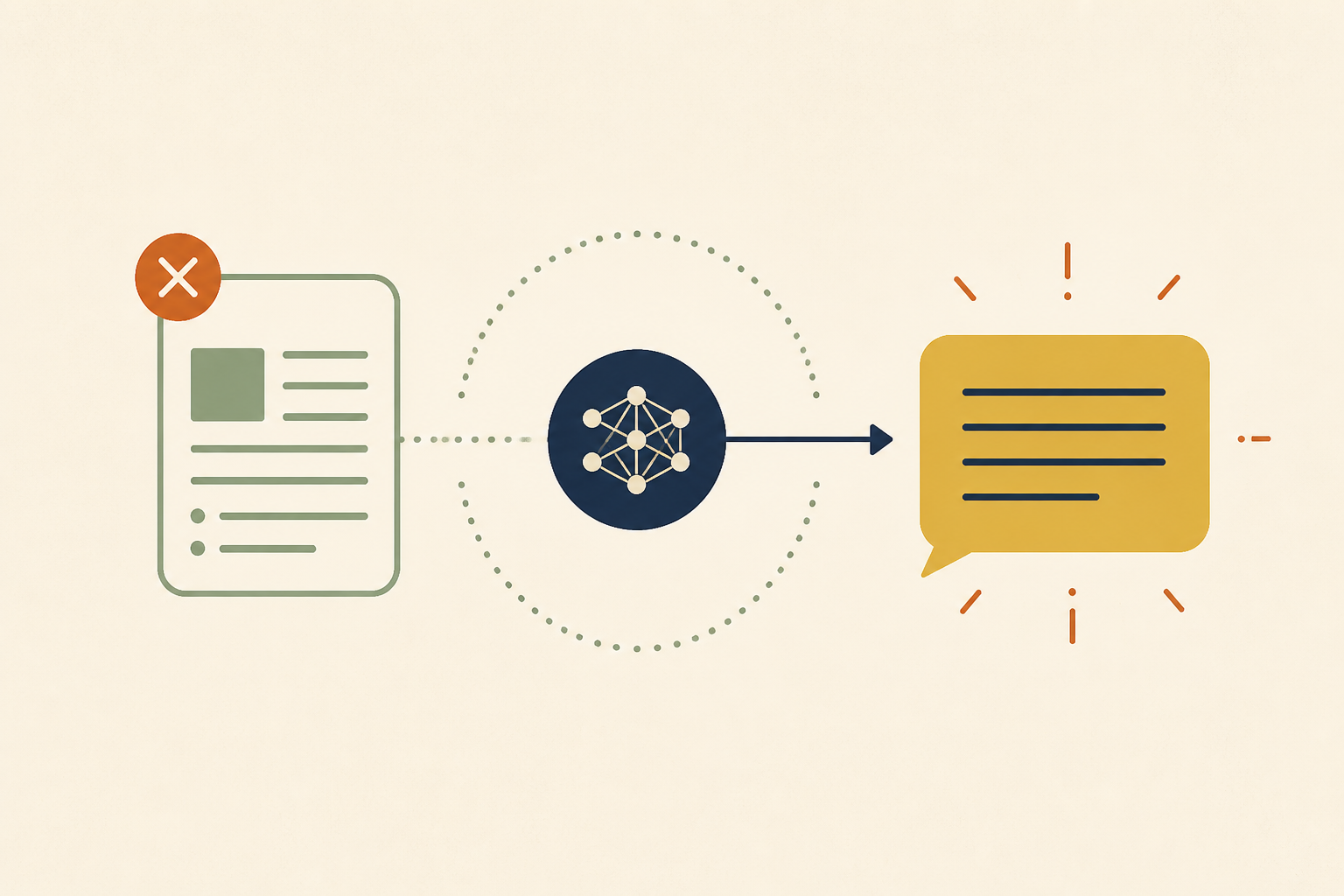
The detail everyone skipped is the root cause: an engineer acted on inaccurate advice that an AI agent had inferred from an outdated internal wiki. There was no "hallucination" in the traditional sense, and no broken logic in the syntax. Nobody wrote bad code. They wrote the wrong code perfectly.
What actually failed, step by step
To understand why this matters, we have to walk the chain of events. In this incident, no single link in the process malfunctioned according to its design:
- The Wiki: It was stale. This is the natural state of almost every internal wiki in existence.
- The Agent: It synthesized a confident answer based on the data it was given. This is exactly what LLMs are designed to do.
- The Engineer: They trusted a plausible answer from a tool that is usually right. This is the very premise of adopting AI productivity tools.
This is a stale-evidence failure. The resulting code change was a correct implementation of a false premise. If a wiki says a specific flag is required for a deployment to succeed, and an agent writes a PR to add that flag, the code is technically "correct." The failure exists entirely in the delta between the documentation and the current state of the production system.
Why senior sign-off cannot catch it
In the wake of these reports, the industry's reflex—and Amazon’s reported remedy—was to mandate senior engineer sign-off on AI-assisted changes. If verification is the bottleneck, delegating it to those with the most context seems rational.
However, senior sign-off has almost no purchase on a stale-evidence failure. When a reviewer looks at a diff, they are inspecting the artifact. They see the logic, the syntax, and the intent. But a diff does not contain the premise, the source, or the timestamp of when that source was last verified.
If a senior reviewer sees a change that perfectly follows a documented (but outdated) procedure, they will approve it. The reviewer’s internal question is usually "Does this code do what the author intended?" rather than "Is the underlying assumption of this entire PR still true in production today?"
The statistics everyone is citing measure the other thing
The data points we use to track AI's impact on software quality are looking in the wrong direction. Veracode measures whether generated code is secure. DORA measures throughput against stability. Faros has noted that incidents per pull request are up 243 percent.
While these metrics are vital, they all evaluate the output. None of them can detect a correct output built on a false input. A stale-wiki incident appears in these datasets as a "clean" change that happens to break production. As we have argued previously, the industry has staffed the "generation" side of the AI boom without staffing the "verification" side, but even then, we are verifying the wrong thing.
Key Takeaway: The most dangerous AI risk isn't rogue code; it's the "correct" implementation of a premise that is no longer true, a failure class that remains invisible to standard code review.
And why 'detect faster' does not reach it either
Some, like James Smith in Shipped Not Done, argue that the answer is "sensing" rather than "gatekeeping"—better instrumentation to catch errors as they happen. This is the correct approach for emergent runtime faults, such as a retry loop that behaves poorly only under high latency.
But a stale premise is not emergent. It is wrong the moment the engineer hits "merge." It is an environmental mismatch that is checkable at the moment of the decision against a source’s last-modified date. Detection is a reactive safety net; what we need is a proactive control on the evidence itself.
What a control on evidence looks like
If the failure is in the evidence, the control must attach to the evidence. A robust verification process for AI-assisted changes should include:
- Citations with Metadata: Agents must carry their sources. A PR should not just show the code; it should show the snippet of the wiki it relied on, the retrieval timestamp, and the wiki page’s last-modified date.
- Independent Cross-Checks: A second check should be independently sourced. If two agents—or an agent and a human—read the same stale synthesis, they will reach the same wrong conclusion.
- Premise Validation: The review question must shift. Instead of "Is this diff correct?", the reviewer must ask, "Is the premise of this change still true?"
This approach is how we designed the Operate platform. Our pipeline separates these concerns: a Context agent gathers evidence, a Root Cause agent forms a conclusion, and a Verification agent—running an entirely different model—checks that conclusion against the raw evidence. By keeping the audit trail as the primary artifact, the human reviewer isn't just checking a diff; they are checking the reasoning.
The part the twenty-person company can actually do
At a company like Amazon, senior sign-off is an expensive hurdle. At a twenty-person startup, it’s a brick wall. Smaller teams cannot afford to have their most experienced engineers read every line of AI-generated code.
However, an evidence trail is not headcount-bound. Making a tool cite its sources and checking the "freshness" of those sources is a technical configuration, not a management layer. It is a control that a small team can adopt in an afternoon to prevent a "correct" change from taking down their system.
What to do on Monday
- Require Citations: Do not accept agent-generated advice or code without linked sources and timestamps.
- Update Review Checklists: Add a single line: "What is the underlying premise of this change, and is it verified against current production state?"
- Audit Your Sources: Identify which internal docs your agents are actually using. If your "Deployment Guide" hasn't been touched in two years, delete it or mark it as unreliable for AI consumption.
- Enforce Independent Checks: If using automated verification, ensure the verifier retrieves its own context rather than relying on the proposer’s summary.
Sources & further reading
- According to The Register, Amazon insists AI coding isn't the source of outages, despite reports of a "trend of incidents."
- According to James Smith in Shipped Not Done, the stale-wiki root cause "makes the case rather than undermining it" for new types of human-in-the-loop systems.
- Additional context on AI verification and production access provided by practitioner discussions on X and Medium.