Managed SRE Services Should Answer Who Owns Production Work
Compare managed SRE services by the work they own, coverage, permissions and handoffs. Use a responsibility matrix before choosing a provider.
Quick Answer
Managed SRE services should be evaluated by ownership, not by the monitoring screens or AI answers they add. The buying question is who detects, triages, diagnoses, approves mitigation, executes changes, communicates impact and prevents recurrence when production breaks. A responsibility matrix exposes gaps between an internal team, a tool-only purchase and a provider-plus-platform model before a contract turns vague help into an unclear handoff.
Managed SRE services are outside production operations help where a provider takes defined responsibility for some SRE work. I do not treat that as the same thing as buying alerts, dashboards or an AI investigation tool.
The painful gap appears when an incident crosses boundaries. Monitoring finds a symptom. An AI system explains a likely cause. A vendor engineer gives advice. Then your team still has to decide who mitigates, who tells customers, who writes the follow-up and who owns the next version of the runbook.
I would evaluate managed production operations with a responsibility matrix before I compared feature lists. This post covers investigation assistance, production work ownership, provider models, coverage rules, access boundaries, a copyable checklist and a bounded pilot for managed SRE services.
Managed SRE Services Start With Work Ownership, Not Monitoring
Managed SRE services start to make sense only when someone names the work they own during an incident. I separate investigation assistance from managed production work because they create different duties, permissions and escalation paths.
Investigation assistance can be valuable. It can read logs, query a database, inspect code paths or draft a likely patch. But it does not automatically own mitigation approval, command execution, customer communication or recurrence prevention.
Managed production work adds a stronger claim. I expect it to say which production tasks the provider performs, which ones the customer approves and which ones stay with the internal team. That distinction matters more than a polished incident dashboard.
| Evaluation Area | Investigation Assistance | Managed Production Work |
|---|---|---|
| Detection | Surfaces or explains a signal from monitoring or logs | Owns a named detection path or watches a defined queue |
| Diagnosis | Produces evidence, hypotheses or a patch draft | Drives diagnosis to an agreed decision point |
| Mitigation | Suggests commands, rollbacks or code changes | Performs or coordinates an approved mitigation if permission allows |
| Communication | May summarize findings for the incident channel | Owns an agreed internal or customer-facing update path |
| Follow-Up | May draft an RCA or action list | Owns assigned recurrence-prevention work to completion |
I read vendor pages from Mission Cloud, DataTroops and 27Global on 2026-10-03. The offers span managed cloud operations, managed SRE services and explicit AI-plus-engineer positioning, which is exactly why I would force the work boundary into writing.
Pro tip: I ask vendors to rewrite one recent incident as a task list. If the list has no owner for mitigation, communications and recurrence prevention, I treat the service as assistance until the contract says otherwise.
A Managed SRE Services Responsibility Matrix Names the Owner Before an Incident
A managed SRE services responsibility matrix answers the buying question before production pressure starts. I want one row per incident task, one named owner per row and one approval rule for anything that can change customer traffic or production data.
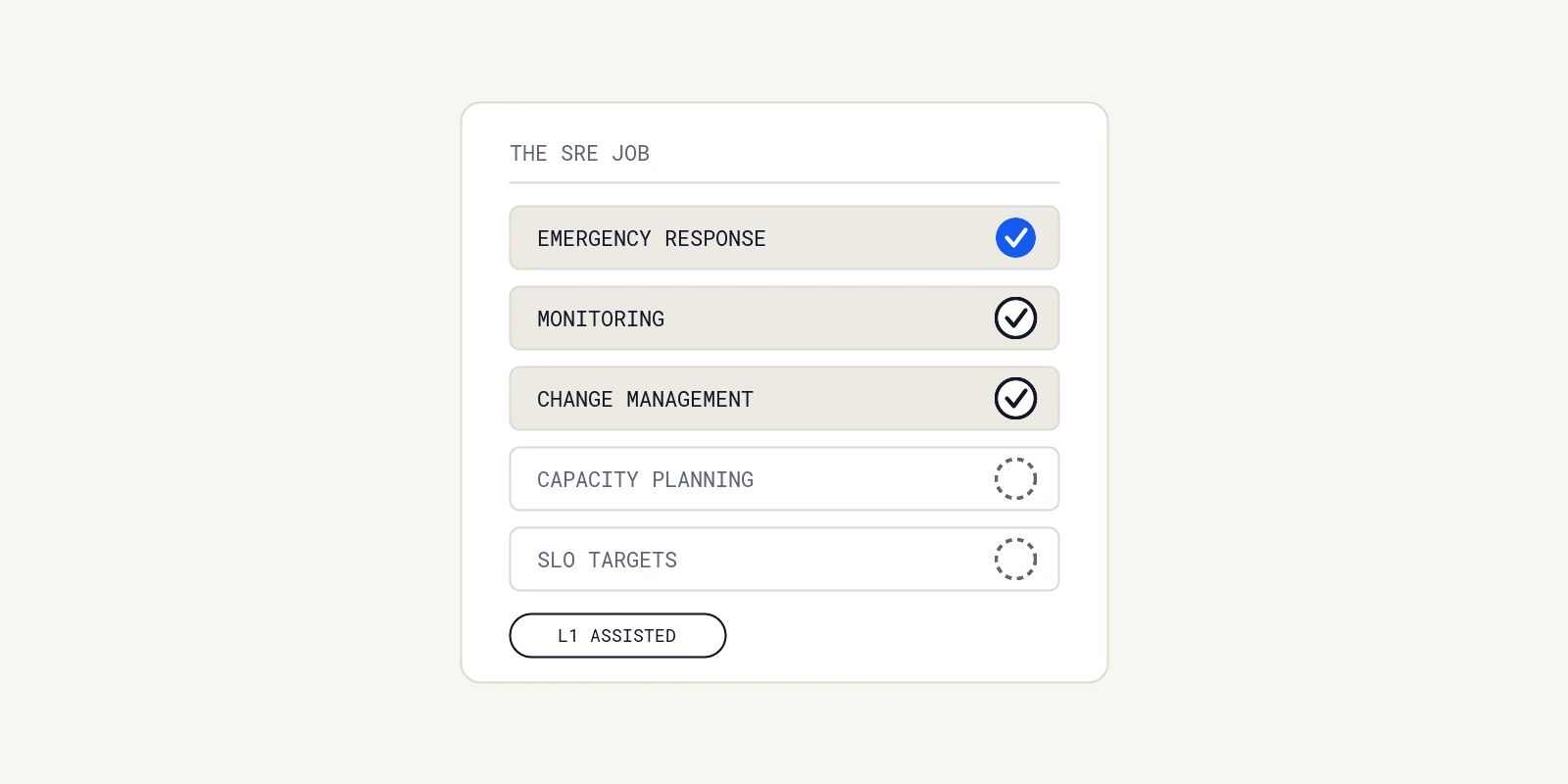
The minimum useful matrix has seven production work rows. Those rows are detection, triage, diagnosis, mitigation approval, execution, customer communication and recurrence prevention. If a vendor cannot fill those rows, I assume my team still owns the blank cells.
| Production Work | Customer Owner | Provider Owner | Approval Needed | Evidence Expected |
|---|---|---|---|---|
| Detection | Internal on-call or platform team | Provider if contracted to watch alerts | No approval for notification | Alert name, service, time and affected signal |
| Triage | Incident commander or first responder | Provider if contracted to classify impact | Approval only when severity changes policy | Impact statement and suspected blast radius |
| Diagnosis | Service owner or SRE | Provider or AI-plus-engineer team if contracted | No approval for read-only investigation | Logs, queries, code references and ruled-out causes |
| Mitigation Approval | Engineering lead or incident commander | Usually recommends, unless delegated | Approval before rollback, config change or traffic move | Proposed action, risk and rollback path |
| Execution | Internal engineer by default | Provider only with explicit write permission | Approval before production write or deploy | Command, PR, ticket or change record |
| Customer Communication | Support, comms or incident commander | Provider only if contract includes it | Approval before external message | Status wording and timing record |
| Recurrence Prevention | Service owner and engineering manager | Provider if contracted for backlog work | Approval for roadmap or code changes | RCA, patch, runbook change or monitoring change |
I like this table because it exposes polite ambiguity. A provider can say it helps with incidents, and that may be true. The matrix asks a harder question. Does help mean advice in Slack, an engineer driving diagnosis, or an approved operator making the change?
Say you run a five-person platform team that supports a PostgreSQL-backed SaaS product. A noisy p99 latency alert fires during business hours. Your AI tool points to a query plan change, and the provider confirms it from logs and database evidence.
The unresolved question is still practical. Who pauses a risky deploy, who asks the database owner to approve a temporary index, who tells support what customers may see and who checks the same query next week? I would not sign a managed SRE services agreement that leaves those answers to habit.
Here is an illustrative completed example for that scenario:
| Production Work | Named Owner in the Example | What the Owner Does |
|---|---|---|
| Detection | Internal on-call | Receives the p99 alert and opens the incident channel |
| Triage | Internal incident commander | Confirms customer-facing latency and sets severity |
| Diagnosis | Provider SRE with AI investigation support | Reads logs, database evidence and code paths, then proposes cause |
| Mitigation Approval | Customer engineering lead | Approves the temporary index or chooses rollback |
| Execution | Customer database owner | Applies the approved database change |
| Customer Communication | Customer support lead | Sends customer-facing status wording approved by engineering |
| Recurrence Prevention | Service owner | Adds the follow-up issue and assigns the long-term fix |
That example does not make the provider weak. It makes the contract honest. The provider owns diagnosis work, the customer owns production writes and customer messaging, and nobody has to negotiate permissions during an outage.
I also ask for the negative case. If the provider diagnoses a cause but my service owner disagrees, who has decision authority? Managed SRE services should name the decider, not just the helper, because two confident opinions can stall a mitigation.
The same rule applies to recurrence prevention. A post-incident review often creates tasks that outlive the outage. I want the matrix to say who writes the RCA, who updates the runbook, who changes alerts and who checks that the same failure mode did not return.
Managed SRE Services Models Change Permissions and Handoffs
Managed SRE services differ most sharply in the permissions they require and the handoffs they leave behind. I compare an internal team, an AI tool-only purchase and a provider-plus-platform model because each one moves a different part of production work.
| Model | What It Usually Owns | What the Customer Usually Keeps | Permission Risk to Clarify | Handoff to Test |
|---|---|---|---|---|
| Internal Team | Detection, diagnosis, mitigation and follow-up | Staffing, rotation design and prioritization | Internal access sprawl and unclear break-glass use | Shift handoff and service-owner escalation |
| AI Tool-Only Purchase | Evidence gathering, hypothesis generation or patch drafting | Approval, execution, communications and recurrence prevention | Read scope, query logging, model inference and repository access | Human review from answer to action |
| Provider-Plus-Platform | Contracted SRE work plus tooling support | Final authority where contract keeps it with the customer | Remote engineer access, write permissions and data exposure | Provider-to-customer approval and closure |
I do not see this as a maturity ladder. A small team may need provider hours before it needs another internal hire. A larger team may prefer a tool-only purchase because it wants faster diagnosis but will never delegate production writes.
If I am evaluating an AI SRE rather than a people-heavy provider, I put access boundaries in writing early. A self-hosted, read-only access model changes the permission conversation, but it does not by itself assign mitigation, communication or recurrence prevention to a vendor.
The provider-plus-platform model needs the cleanest handoff test. I ask the vendor to describe the exact path from alert to approved action. A vague answer means the real work will land in the incident channel, which usually means the internal on-call still owns coordination.
The tool-only model needs a different test. I ask what happens when the answer is plausible but incomplete. If my engineer must re-run every log search and database query before acting, the tool may reduce search time, but it has not reduced ownership.
Pro tip: I ask for the first human sentence after the tool or provider finds a likely cause. If that sentence starts with someone on my team asking what to do next, the handoff still needs design.
Managed SRE Services Coverage Must Define Hours, On-Call and Parallel Incidents
Managed SRE services coverage should define when humans respond, how on-call escalation works and what happens during simultaneous incidents. I would rather see a narrow coverage promise with clear limits than a broad phrase that hides staffing assumptions.
• Business-Hours Coverage
Business-hours coverage can fit teams that mainly need production work during the day. I still ask what happens at the edge of the day because many incidents do not respect a calendar handoff.
A specific example helps. If an alert fires near the end of the provider's business day, I want the contract to state if the provider continues the investigation, hands it to my on-call or pauses until the next covered window.
• On-Call Coverage
On-call coverage sounds simple until I ask who carries the pager. Managed SRE services may include a provider rotation, a customer rotation or a shared path where the provider investigates after the customer opens an incident.
I would document the first responder and the escalation timer in the same place. Without that, a critical alert can become a queue item while two teams assume the other one has acknowledged it.
• Parallel Incident Coverage
Parallel incident coverage matters because production failures bunch together. A single provider engineer may handle one database incident well, but a second cloud incident can expose an unspoken capacity limit.
I ask for the simultaneous-incident rule in plain language. If two incidents open at once, I want to know which severity wins, who declares priority and what evidence the lower-priority incident still receives.
The 2026-10-03 review of Mission Cloud, DataTroops and 27Global showed a mix of managed cloud operations, managed SRE services and AI-plus-engineer language. That mix makes coverage wording a contract issue, not a marketing issue.
Managed SRE Services Need Clear Rules for Hosting, Inference and Remote Access
Managed SRE services need separate answers for hosting, model inference and remote engineer access. I split those topics because a self-hosted agent, a hosted model and a remote human operator create different security reviews.
• Local Hosting
Local hosting tells me where the operational system runs. If a tool runs inside my infrastructure as a Docker image, I still need to ask what network access it needs, which logs it can read and how every query gets recorded.
I do not equate local hosting with full data residency. Investigation context may go to the team's AI provider, or it may stay inside the network with a self-hosted model. The buyer has to choose and verify that path.
• Model Inference
Model inference tells me where incident context goes for reasoning. A bring-your-own-provider model can fit a team that already approved an AI vendor, while a self-hosted model can fit stricter network boundaries.
The point is not to ban every external path. I want the path written down. Logs, database excerpts, code references and patch context carry production meaning, so the inference route belongs in the managed SRE services review.
• Remote Engineer Access
Remote engineer access tells me what people outside the company can see or do. Read-only access, no repository writes and no production write permission create a different risk profile than an operator who can run commands.
I also ask how access is revoked and audited. Every query should have a record, and every production write should have a human approver. If a provider needs write permission, I want the permission, approval gate and rollback path in one table.
Pro tip: I keep AI model access and human engineer access in separate rows. Teams often approve one and accidentally imply the other.
A Copyable Managed SRE Services Discovery Checklist Turns Sales Claims Into Answers
A managed SRE services discovery checklist turns vendor claims into comparable answers. I use it to replace phrases like incident support with named tasks, permissions, coverage windows and evidence requirements.
• Blank Responsibility Matrix
Copy this matrix into the buying process before procurement starts. I prefer to fill it with the vendor on a call, then send it back as a written artifact for confirmation.
| Work Item | Customer Owner | Provider Owner | Tool Owner | Approval Gate | Evidence Artifact |
|---|---|---|---|---|---|
| Detection | |||||
| Triage | |||||
| Diagnosis | |||||
| Mitigation Approval | |||||
| Execution | |||||
| Customer Communication | |||||
| Recurrence Prevention |
The blank cells matter. If a provider says a row depends on the incident, I ask for the default. Managed SRE services can still have exceptions, but they need a starting owner before a pager wakes someone up.
• Discovery Checklist
I keep the checklist short enough to use during a sales call. Long questionnaires often hide the answer I need, which is who does the work when production is failing.
| Question | Answer I Want in Writing |
|---|---|
| Who acknowledges the first page | A named team or role |
| Who declares severity | A named customer or provider role |
| Who may query logs and databases | Read scope and audit trail |
| Who may inspect code | Repository scope and access mode |
| Who may change production | Permission level and approval gate |
| Who writes the RCA | Named owner and due path |
| Who owns recurrence prevention | Owner for backlog, patch or runbook work |
| What happens after hours | Coverage window and escalation path |
| What happens during simultaneous incidents | Priority rule and staffing answer |
| Where does AI inference run | Provider path or self-hosted model path |
I would add one company-specific row for the riskiest system. For a payments system, that might be database write access. For a Kubernetes platform, it might be who can change traffic routing or restart workloads.
• Illustrative Completed Example
Here is a completed example for a team that wants AI investigation and provider SRE support, but keeps production writes internal. It is hypothetical, and I would expect each buyer to change the owners.
| Work Item | Completed Example |
|---|---|
| Detection | Customer on-call receives the alert |
| Triage | Customer incident commander sets severity |
| Diagnosis | Provider SRE uses tool evidence and posts a cause hypothesis |
| Mitigation Approval | Customer engineering lead approves or rejects the action |
| Execution | Customer engineer applies rollback, config change or patch |
| Customer Communication | Customer support lead sends approved wording |
| Recurrence Prevention | Customer service owner and provider split agreed follow-up tasks |
This example leaves a lot with the customer, and that may be right. The important part is not maximum delegation. The important part is that managed SRE services make every retained duty visible before renewal pressure or outage pressure changes the conversation.
A Managed SRE Services Pilot Should Measure Completed Production Work
A managed SRE services pilot should measure completed work, not only better answers. I would design a bounded pilot around specific incident tasks and then count which tasks moved from the customer to the provider or tool.
1. Pick a Bounded Slice of Production Work
Start with one system, one coverage window and one incident class. A database latency slice, a Kubernetes restart loop slice or a third-party outage triage slice gives the pilot enough shape to evaluate handoffs.
I avoid a pilot that says the provider will help with everything. That phrasing makes failure hard to interpret. A bounded slice lets me ask if diagnosis, mitigation recommendation or recurrence follow-up actually reached completion.
2. Define Evidence Before the First Alert
The pilot should define acceptable evidence before anyone argues about an incident. Logs, database queries, code references, patch drafts, incident timeline entries and RCA notes all count only if the parties agree they count.
I also define what does not count. A chat summary without the log line or query behind it may help communication, but I would not count it as completed diagnosis work for managed SRE services.
3. Review Work Completion After Each Incident
After each pilot incident, I would mark every matrix row as completed by customer, completed by provider, completed by tool or not completed. That review avoids a common trap where everyone remembers the useful answer and forgets the work that stayed internal.
The final pilot readout should show retained work. If the provider diagnosed three incidents but my team still handled every approval, execution, customer update and recurrence task, I would buy it as investigation help, not as full managed production ownership.
I would also include one no-incident exercise. A tabletop or replayed incident can test access, inference, escalation and approval gates without waiting for production pain. It cannot prove live response, but it can find missing owners.
Choose Managed SRE Services Only After You Know the Remaining Owner
Managed SRE services are worth evaluating when they make production ownership clearer than your current model. I would not buy them to remove ambiguity. I would buy them only after the responsibility matrix shows which work moves and which work stays.
The practical step is simple. Write the seven incident rows, assign a default owner, define permissions, state coverage and run a bounded pilot that measures completed work. If the blank cells remain blank, the customer still owns them.
For teams that want AI investigation inside their own infrastructure with read-only production and repository access, human-reviewed patch drafts and Slack or MS Teams entry points, Operate is one way I would make the investigation boundary explicit while engineers retain execution authority.
Frequently Asked Questions
I read managed SRE services as a contract term, not a job title. Before I trust the label, I ask for a service schedule. It should list incident roles, maintenance responsibilities, reporting cadence and exclusions, so procurement language matches production work.
I draw the line at obligation. A monitoring tool can wake someone up or preserve evidence. I expect a managed SRE services provider to accept a named duty after the signal appears. That duty may be investigation, coordination or follow-up, depending on the contract.
I would treat replacement as an exception, not the default. Even when managed SRE services cover day-to-day operations, an internal leader still needs to own risk tolerance, architecture direction and budget tradeoffs. Customer promises usually need one accountable company leader.
I separate need from convenience. Managed SRE services can begin with read-only evidence gathering, and that is often enough for diagnosis. Write access belongs in a narrower change-management decision. I want named command scope, emergency path, reviewer and revocation process.
I start comparison with one incident scenario and make every vendor walk it. I score the answer by specificity, not polish. A useful response names the first responder, evidence source, approval holder, communication owner, escalation timeout and the work that remains outside the service.
About the author

Operate Team
The team behind Operate
Operate Team builds Operate, a self-hosted AI SRE that reads your logs, databases and code to find the root cause of production issues with evidence, then drafts the fix as a patch for an engineer to review. Operate runs in your own infrastructure with read-only access to your systems.