AWS Outage Postmortem Lessons Your Provider Will Not Write
AWS's latest public postmortem covers October 2025. How to write the customer-side AWS outage postmortem your provider never will, step by step.
Quick Answer
Provider postmortems explain the provider's failure, not the customer's. AWS publishes a Post-Event Summary only for incidents with broad, significant impact, and its list ends at the October 2025 DynamoDB event. Later incidents reached customers through press reports, statements and other companies' write-ups. Teams get the real lessons by mapping their own blast radius, comparing timelines, auditing single-zone exposure and assigning dated actions after every provider outage.
An AWS outage postmortem is the public write-up AWS publishes after a major service disruption, which AWS calls a Post-Event Summary. It explains what failed inside AWS and what AWS will change. We read each one closely, and it can never explain why our own systems failed the way they did.
That gap matters more as public write-ups become rarer. The last entry on AWS's summary page is the October 2025 DynamoDB event. Incidents since then reached customers through a company statement and another company's postmortem, or not at all.
In this post we cover when AWS publishes, what the October 2025 summary taught and could not teach, the incidents that never got one, and a five-step customer-side postmortem you can run after the next provider outage.
AWS Publishes a Post-Event Summary Only Past a Threshold
AWS states its rule on the Post-Event Summaries page. When an issue has "broad and significant customer impact" that fails a significant share of control plane calls or infrastructure, or comes from total power or significant network failure, AWS commits to a public summary after the issue closes.
That threshold is about AWS's footprint, not yours. An incident that hits one zone, one service or one region can stop your business while staying below the bar. We treat the absence of a summary as normal, not as a sign that nothing important happened.
As of 7 October 2026, the page lists the DynamoDB disruption dated October 19, 2025 as its newest entry, and the one before it is from July 2024. Here is how the recent incidents we track reached the public.
| When | What happened | Public explanation |
|---|---|---|
| October 19-20, 2025 | DynamoDB DNS failure in us-east-1 with knock-on EC2 and load balancer impact | Full AWS Post-Event Summary |
| December 2025 | AWS Cost Explorer interruption in one region, linked in press reports to an AI coding tool | No summary, an Amazon statement disputing the reports |
| May 7, 2026 | Cooling failure in a us-east-1 data hall that took instances and volumes offline | No AWS summary, a detailed postmortem from Coinbase |
What the October 2025 Summary Told Customers and What It Could Not
The October 2025 summary is the most recent public AWS postmortem, and it is a good document. AWS traced the root cause to "a latent race condition in the DynamoDB DNS management system that resulted in an incorrect empty DNS record" for the regional endpoint, and it committed to specific fixes.
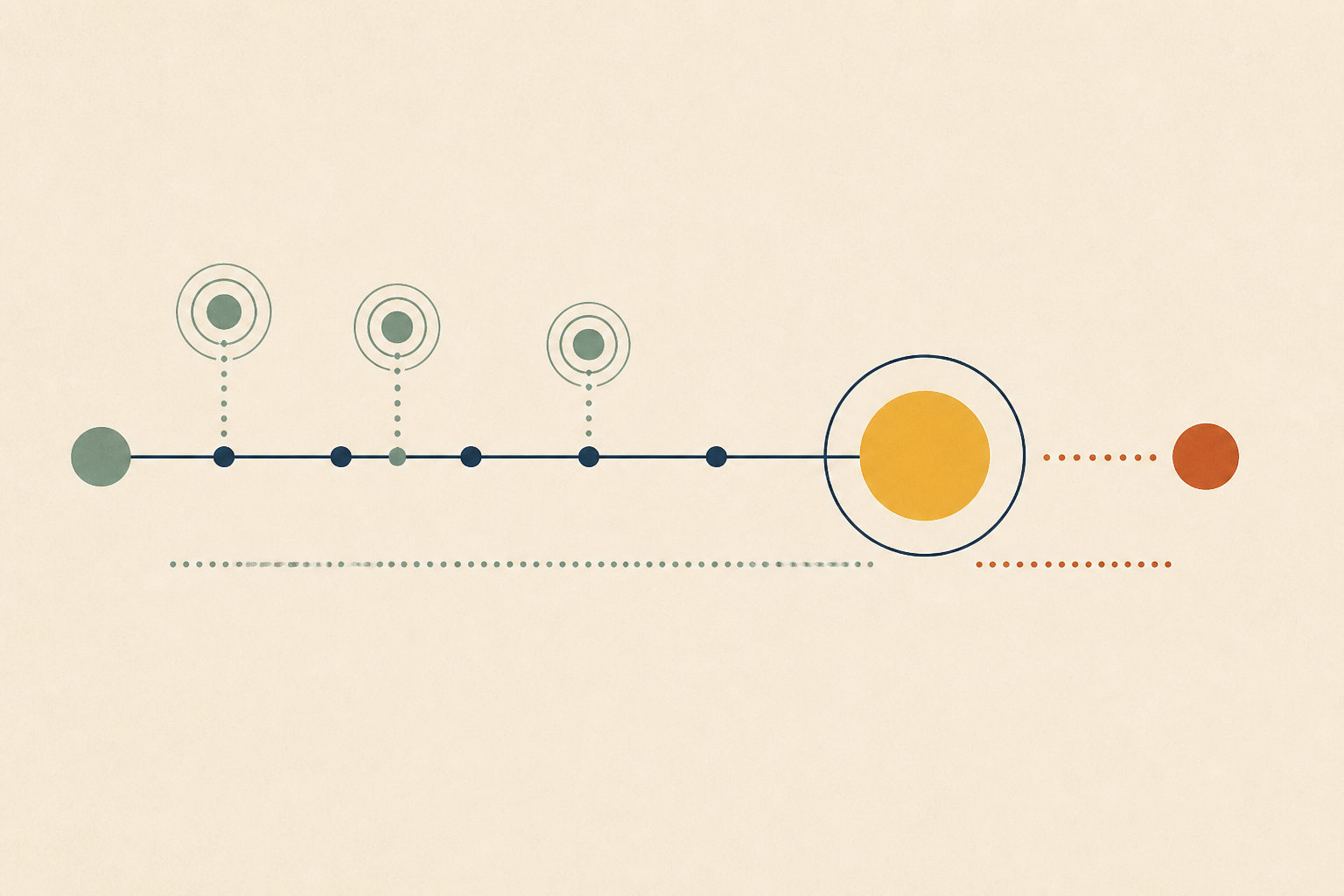
The timeline is the part we found most useful. Impact ran from 11:48 PM PDT on October 19 to 2:20 PM PDT on October 20, in three periods. DynamoDB DNS was restored by 2:25 AM, yet new EC2 launches failed until 10:36 AM, and some new instances had connectivity issues until 1:50 PM.
That gap carries the lesson for customers. Fixing the trigger took under three hours, and the systems built on top took most of a day to converge. We saw the same pattern in other providers' outages, which we wrote about in the stuck-state postmortem.
What the summary could not say is everything on your side of the boundary. It could not tell you which of your services called DynamoDB, why your failover did or did not trigger, how your retries behaved, or which customers felt it. Only your own root cause analysis answers those, because only you hold the logs and traces from your side.
The Incidents That Never Got a Public AWS Summary
The two later incidents show what happens when no summary arrives. Each one left customers to piece the story together from other sources.
In December 2025, press reports linked a 13-hour interruption to an Amazon AI coding tool. Amazon disputed that account, calling the interruption "the result of user error" and tracing it to misconfigured access controls rather than AI. Amazon described an extremely limited event affecting AWS Cost Explorer in one of its 39 geographic regions, and added mandatory peer review for production access.
In May 2026, the detailed public account came from a customer. Coinbase published a postmortem of its May 7 outage, which left most of its services unavailable or degraded for roughly eight hours. Chiller units failed in one data hall in us-east-1, and Coinbase's matching engine, a Raft cluster inside a single placement group, lost quorum when three of its five nodes went down.
Coinbase also reported a defect in the control plane of AWS's managed Kafka service that stopped partition leaders from being reelected, which stretched recovery further. Its closing is the line we would pin above every provider review, a standard that rests "entirely on whether we have built systems resilient enough to withstand one."
The Coinbase write-up is the model we would follow. It explains the provider's trigger in one paragraph and spends the rest on Coinbase's own design choices and what it will change.
A Five-Step Customer-Side AWS Outage Postmortem
We run the same five steps after any provider incident that touched us, even when the provider publishes nothing. The Google SRE book defines the goal well. "A postmortem is a written record of an incident, its impact, the actions taken to mitigate or resolve it, the root cause(s), and the follow-up actions to prevent the incident from recurring."
1. Map Every Service That Touched the Failed Dependency
We use tracing and dependency maps to list every service that called the affected AWS service, region or zone during the window, not only the ones that alerted. The useful finds are silent dependencies, such as a logging or auth call that quietly blocked a critical path.
2. Put Your Timeline Next to the Provider's
We line up our first alert, our first customer report, the provider's first status update, our mitigation and our full recovery. If our alerts fired well before the status page moved, our monitoring did its job, and the question becomes why our response did not.
Reconstructing that timeline from logs is the slowest step, and it is the step an AI agent that investigates with evidence can draft for a reviewer. Either way, every timestamp should link to the log line or graph it came from.
3. Audit Single-Zone and Single-Region Exposure
Coinbase's quorum loss came from placing a whole cluster in one placement group for latency, so a single facility problem took out most of it at once. We look for the same pattern in our own infrastructure code, such as databases, NAT gateways or caches pinned to one availability zone, and control-plane tools that only run in one region.
4. Record What Monitoring Saw, Missed and Misattributed
We note which dashboards turned red, which stayed green while users failed, and which alerts blamed the wrong component. Cached health checks that keep passing during a DNS failure are a common miss, and they belong in the write-up.
5. Assign Dated Actions With Owners
Each action gets an owner and a date, or it does not count. We aim for at least one architecture change, one monitoring change and one runbook change, and we review them at the next provider incident. We keep these records searchable, as we argued in postmortem records that answer questions.
Pitfalls That Waste a Provider Outage
Three habits turn a provider incident into lost learning. We check for each one in review.
- Trusting the status page over your own signals, when your latency and error graphs are the faster, more specific evidence.
- Treating the outage as an act of nature, when the provider failure was outside your control but your blast radius was not.
- Forgetting the control plane, when deploy tooling, identity or consoles in one region can tie you to that region even if your data lives elsewhere.
The first fifteen minutes of a provider outage need a different playbook from the postmortem. We cover deciding "is it us or the provider" in our upstream outage triage protocol, and the same thinking applies to AI model providers, as in the correlated model API outage.
When a Customer-Side Postmortem Is Not Worth Writing
We do not write a full postmortem for every provider blip. Two situations call for something lighter.
• The Outage Never Reached Your Users
If failover worked, no customer noticed and no alert misbehaved, a short note in the incident log is enough. We record what protected us, so nobody removes it later by accident.
• Nothing on Your Side Could Change the Outcome
Sometimes a dependency has no alternative and the impact was what any design would see. We still log the incident, then write a full review only when the same dependency hurts us a second time.
Write the AWS Outage Postmortem for Your Side of the Boundary
We would pick the last provider incident that touched you and run the five steps this week, starting with the dependency map. The actions it produces are worth more than any summary the provider writes.
An AWS outage postmortem from your own team turns someone else's failure into a list of changes you control. Assembling that evidence is the work Operate takes on. It brings the evidence from your logs, databases and code together through read-only adapters, and proposes any code fix as a patch file an engineer reviews and applies.
Frequently Asked Questions
Yes, as Post-Event Summaries, but only for incidents with broad and significant customer impact. We check the summaries page after any major event. Smaller or single-zone incidents often get only status page updates or account notifications instead, so customers should not wait for a public document.
AWS traced it to a latent race condition in DynamoDB's DNS management system, which left an empty DNS record for the us-east-1 endpoint. We point people to the knock-on effects too, because EC2 launches and load balancers stayed impaired for hours after DNS was restored.
There is no single public count, because most incidents are partial and regional rather than total. We judge it by our own exposure instead. Tracking how often provider incidents touched our services in a year is far more useful than any headline number about AWS as a whole.
It is the review your own team writes after a provider outage, covering your blast radius, timeline, monitoring and design choices. We keep the provider's root cause to a paragraph and spend the rest on what we can change, the way Coinbase did after May 2026.
We give it to the team that owned the most affected service, with help from whoever ran the incident. One named author keeps it moving. Reviewers from platform and security should check the dependency map and zone exposure, since those findings usually cross team boundaries.
About the author

Operate Team
The team behind Operate
Operate Team builds Operate, enterprise AI agents for production operations. Operate answers production questions from Slack and Microsoft Teams, investigates alerts, and reviews performance, security and cost. It finds the root cause with evidence and proposes a fix for an engineer to review, with controlled access to your systems.