The Pipeline Was Green and It Deployed Nothing: A Taxonomy of Steps That Succeed by Doing Nothing
Pipeline config bugs almost always fail toward doing less, so they never raise an error. A taxonomy of steps that succeed by doing nothing and how to catch them.
The Pipeline Was Green and It Deployed Nothing: A Taxonomy of Steps That Succeed by Doing Nothing
TL;DR: A green checkmark in a CI/CD pipeline only guarantees that no step raised an explicit error, not that any intended work was performed. To prevent silent deployment failures, engineers must transition from checking exit codes to asserting the specific effect of each pipeline step—such as the count of targets updated or tests executed.
The bug that fired twice, in opposite directions
On August 2, 2026, DevOps practitioner Mandar Gharat documented a classic, yet terrifyingly common, ci cd pipeline failure mode. The incident involved a Jenkins pipeline that began behaving erratically. Initially, deployment stages were firing for targets that no user had selected. When a filter was implemented to rectify this, the behavior inverted: every single target was skipped.
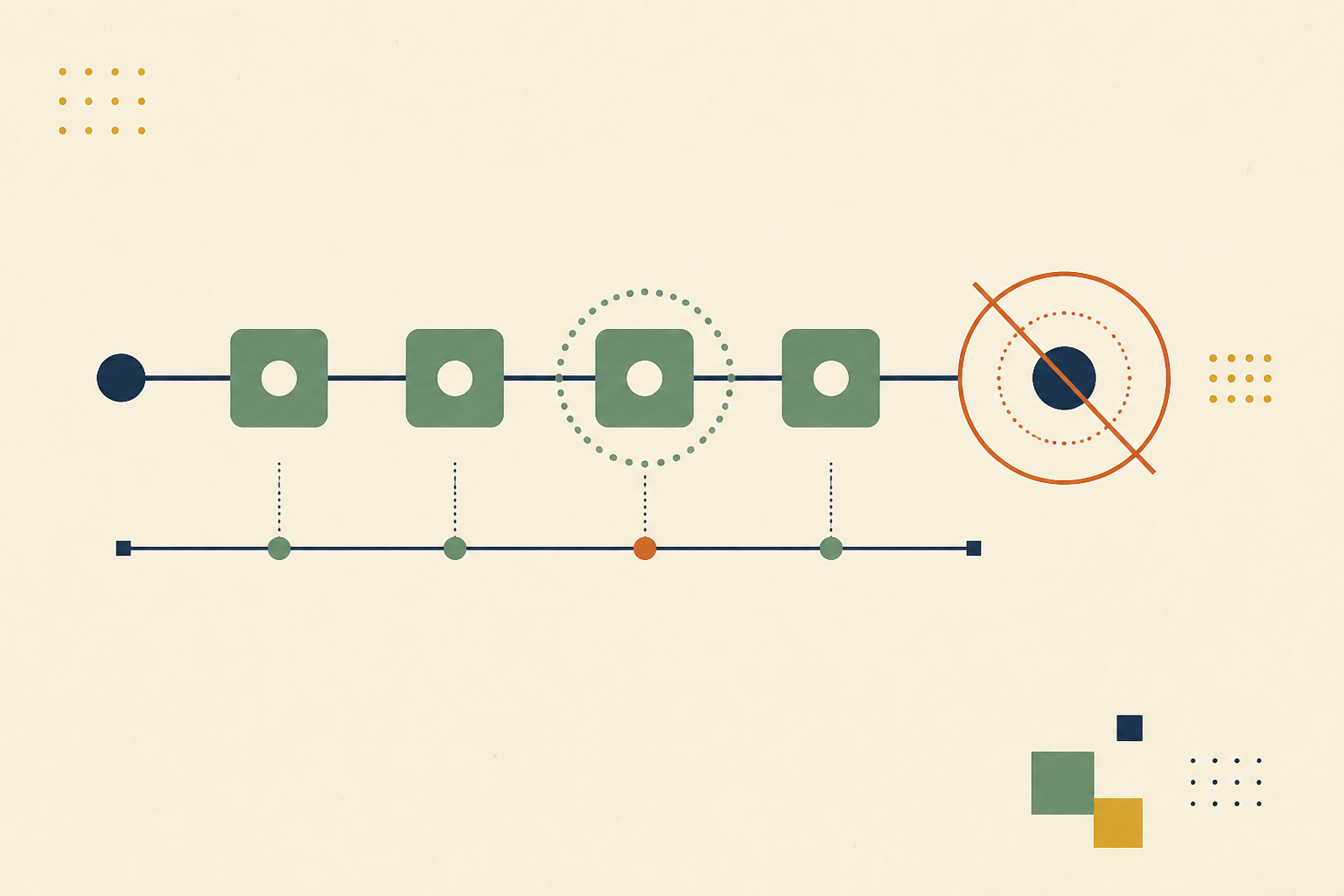
The root cause was a combination of an unused parameter and a single character mismatch—a hyphen where an underscore belonged—which broke an exact string comparison. Throughout both phases of this bug, the pipeline remained green. The second iteration of the bug was strictly worse than the first, yet to the monitoring tools and the operator, it looked strictly healthier. This highlights the central danger of modern delivery: a pipeline that successfully does nothing is indistinguishable from a pipeline that successfully does everything.
Why config bugs fail toward doing less
The mechanism behind this is a fundamental property of logic: a comparison that does not match returns an empty set. In almost every programming language and pipeline DSL (Domain Specific Language), iterating over an empty set is not an error.
If your filter logic is flawed, the loop simply never executes. Every layer between the bug and the operator—the loop, the step, the job, and the pipeline—reports success because none of them were asked how many things they acted on. Contrast this with a traditional build failure, where a compiler is asked to produce a specific artifact; if the artifact is missing, the process errors out. In deployment and orchestration, however, we are often working with variable counts, and our systems are biased toward silent omission rather than loud failure.
Key Takeaway: A green pipeline is a claim that no step failed, but without effect assertions, it is not a proof that any work was actually performed.
A taxonomy of steps that succeed by doing nothing
To defend against ci cd pipeline failure, we must recognize the specific ways these no-ops manifest.
1. Zero-match deploy filters
As seen in the sourced case, a regex or string comparison error results in a target list of zero. The pipeline logs show "Success," but the production environment remains unchanged.
- Assertion:
count(target_list) == expected_count
2. Empty test collection
A test runner misconfiguration causes it to look in the wrong directory. It finds zero tests, runs zero tests, and exits with code 0. If your coverage gate is set to "pass if > 80%," it may see 0/0 and pass the build.
- Assertion:
tests_executed > floor_value
3. Stale image, fresh tag
A layer cache serves an old build because a dependency wasn't properly invalidated. The pipeline pushes a "new" tag, but the underlying image digest is identical to the previous version.
- Assertion:
new_image_digest != previous_image_digest
4. Skipped-by-condition jobs
A branch or path condition (e.g., on: push: paths:) stops matching after a directory rename. The job is simply omitted from the run. If this was a security scan or a required cleanup, the pipeline stays green while skipping critical gates.
- Assertion: Required jobs must be explicitly present in the run manifest.
5. Migrations that found nothing to run
A migration runner points to the wrong schema or path. It connects successfully, sees no pending migrations in its (incorrect) context, and exits.
- Assertion:
applied_migrations == pending_migrations_count
6. Retention and cleanup jobs
A job designed to delete old logs or data fails to match any rows because the predicate logic is broken. The database doesn't error; it just returns Rows affected: 0. Over time, this leads to storage exhaustion despite a "healthy" cleanup pipeline.
- Assertion:
rows_deleted > 0(if data is expected to exist).
7. Rollouts that reported success prematurely
A deployment tool reports success as soon as the API call is accepted, rather than waiting for the pods to reach a ready state. The pipeline is green while the pods are in a CrashLoopBackOff.
- Assertion: Poll for
Readystatus and compare againstDesiredcount.
8. Artifact publish steps that uploaded an empty directory
A build step fails to output files to the expected /dist folder, but doesn't exit with an error. The subsequent upload step zips an empty directory and successfully sends it to the artifact store.
- Assertion:
artifact_size > min_threshold
The general fix: Assert the effect, not the exit code
The architectural principle for avoiding this category of ci cd pipeline failure is simple: Any step acting on a variable number of things must declare and check that number.
If you are deploying to $N$ targets, the pipeline must assert that $N$ is exactly what was selected by the user or the trigger. If you are running migrations, you must assert the applied set matches the pending set. This creates a "floor" for the operation. If a step can complete without producing tangible evidence that it performed its intended function, it is not a robust step.
Where to put the assertion
Practical placement of these checks depends on your stack:
- In-step: Add shell logic or DSL checks directly within the job (e.g.,
[[ $(ls -1 | wc -l) -gt 0 ]]). - Verification Job: A separate stage that queries the environment after the deployment to verify the new version is actually serving traffic.
- Post-deploy smoke tests: Using external probes to verify the side effects of the deployment.
Note that assertions in the pipeline are also code and are subject to drift. However, the cost of a failing assertion is a red pipeline (which gets investigated), while the cost of a missing assertion is a silent failure (which causes outages).
Why this matters: The second-order cost
When a ci cd pipeline failure is silent, the costs extend beyond the technical. Deploy frequency metrics (DORA) count runs, not effects. If your pipeline is failing silently, your metrics will show high velocity while your actual product remains stagnant.
Furthermore, there is a massive human cost. The change that did not ship is often attributed to the application code, not the infrastructure. Engineers spend hours debugging an application that was never actually updated. This erodes trust in the automation. Once a team has been burned by a lying green check, they resort to manual verification, re-introducing the toil the pipeline was designed to eliminate.
According to Mandar Gharat, these reliability issues in CI/CD demand a shift toward more defensive engineering. This mirrors broader industry trends where operational load is increasing, as noted by recent observations on the growing complexity of modern stacks.
A short audit you can run this week
Ask these six questions of your primary delivery pipeline:
- Does the deployment fail if the list of target servers is empty?
- Does the test stage fail if zero tests are discovered?
- Is there a check to ensure the built image digest differs from the currently running one?
- If a migration script is missing, does the runner exit with a non-zero code?
- Do your artifact upload steps verify that the source directory is not empty?
- Are there "required" jobs that could be silently skipped by a path-filter misconfiguration?
Conclusion
A green pipeline is a claim about work performed. Most pipelines today only prove that no step raised a terminal error, which is a much weaker claim. The gap between "no error" and "work performed" is where the most expensive failures live.
These green no-ops are notoriously hard to catch because they require comparing what a run was supposed to do against what it actually did—two facts that often live in separate systems. At Operate, we treat misbehaving CI as a proactive incident source rather than something a human has to stumble upon. By reading pipeline configuration, run history, and actual deployed state together, Operate identifies these missing assertions and broken comparisons. When it finds a gap, it drafts the necessary patch so you can move from checking exit codes to asserting real effects.
Sources & further reading
- According to Mandar Gharat's analysis of CI/CD reliability, configuration mismatches often lead to healthy-looking failures.
- Practitioner experiences on silent pipeline failures highlight the need for deeper observability.
- Research into operational load suggests that hidden pipeline failures contribute significantly to engineer burnout.
- For more on related failure modes, see our piece on The Pipeline Returned 200 OK and Did Nothing.