The Transactional Outbox Pattern on Day 2: Failure Modes the Tutorials Skip
TL;DR: While the transactional outbox pattern solves the dual-write problem by atomizing database updates and message publishing, it introduces complex operational overhead. In production, teams must actively manage relay stalls, table bloat, and ordering drift to prevent silent data loss and event lag.
The tutorial ends at the happy path
Most engineering tutorials for the transactional outbox pattern follow a predictable arc: show the "dual-write" problem where a database update succeeds but a message queue publish fails, then introduce an outbox table as the atomic bridge. It looks perfect on a whiteboard. But as recent discussions on X (formerly Twitter) highlight, the "happy path" implementation often masks a new set of silent failures.
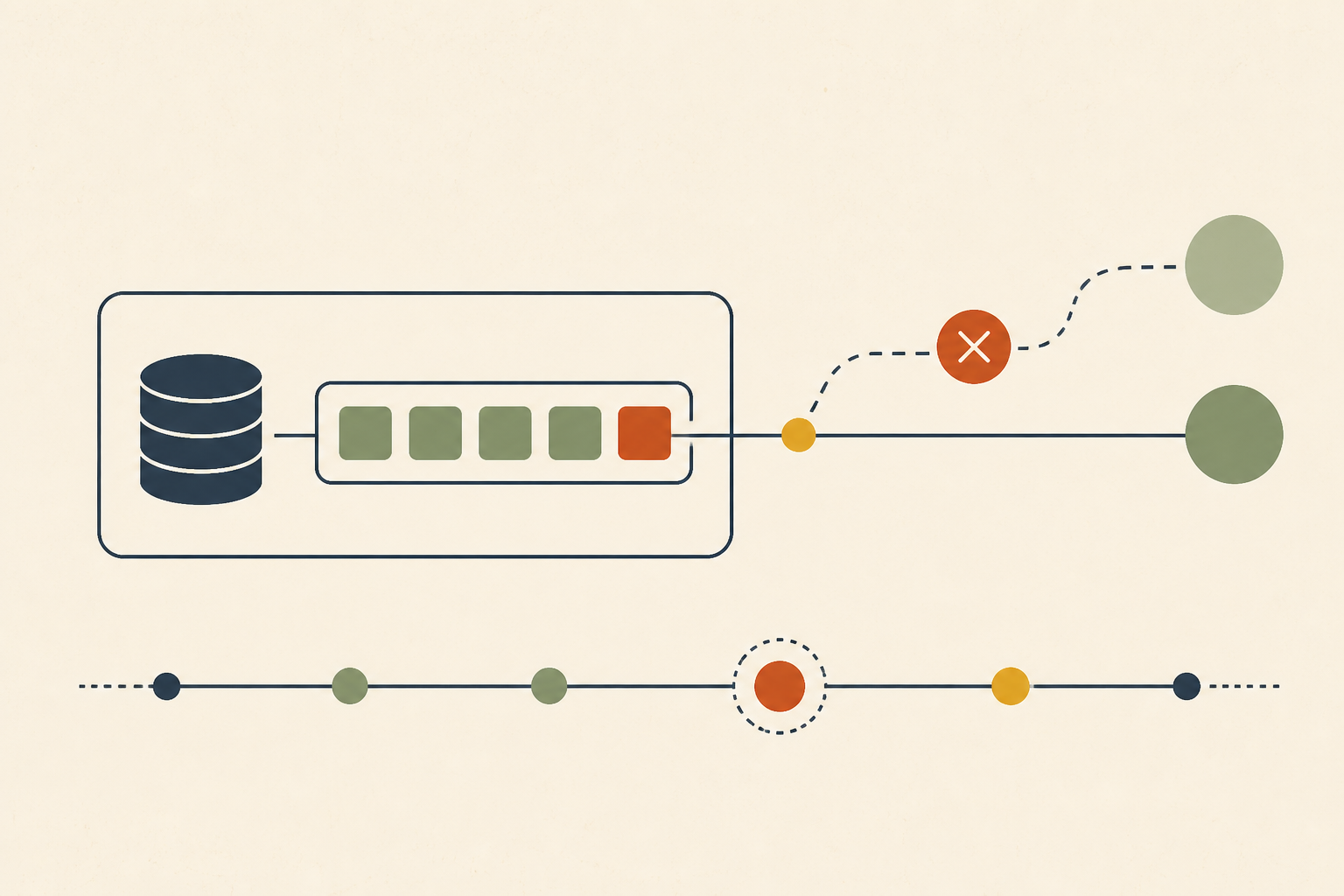
As Ritika Gupta (@RitikaxG) recently observed, if the relay mechanism—the piece that moves records from your database to your message broker—stalls, the database continues to succeed while the downstream job is silently never enqueued. These gaps often surface weeks later during a manual audit. This guide moves beyond the "how to build" and focuses on how to operate the pattern without it becoming your next on-call nightmare.
Key Takeaway: The transactional outbox pattern replaces a hard-to-debug distributed systems failure (dual-writes) with a manageable monitoring problem (relay health and table hygiene).
60-second recap: What the outbox actually guarantees (and what it doesn't)
The transactional outbox pattern ensures at-least-once delivery of messages related to a database transaction. By writing the message to a dedicated outbox table within the same ACID transaction as the business logic, you guarantee that if the data is saved, the message is also saved.
However, the pattern does not guarantee:
- Exactly-once delivery: Your relay might crash after publishing but before marking the row as processed.
- Instantaneous delivery: There is always a non-zero lag between the
COMMITand the relay processing the row. - Automatic ordering: Without careful implementation, concurrent transactions can lead to messages being published out of sequence.
Failure mode 1: The relay stalls
The relay (or "publisher") is the heart of the transactional outbox pattern. Whether it is a polling worker or a Change Data Capture (CDC) process, it can fail.
Common causes include crash loops due to malformed payloads, database lock contention, or a single-instance relay hitting an unhandled exception. Because the primary business transaction is still succeeding, your API health checks stay green while your entire event-driven architecture grinds to a halt.
- Detection: Monitor the unprocessed-row age. If the oldest row in your outbox table is older than 60 seconds, your relay is likely stalled.
Failure mode 2: Outbox lag becomes stale downstream state
In a distributed system, "eventual consistency" is only acceptable if the "eventual" part is fast. As your database scale grows, a single-threaded relay may struggle to keep up with the volume of inserts.
- The Risk: Downstream services (like search indexes or cache invalidators) begin to operate on stale data, leading to "ghost" records in the UI.
- The Fix: Treat outbox lag as a Service Level Objective (SLO). Alert when the delta between the
created_attimestamp and the current time exceeds your business requirements.
Failure mode 3: Table bloat and autovacuum pressure
If you are using the transactional outbox pattern Postgres implementation, you must account for table bloat. Every message involves an INSERT followed by an UPDATE (marking as sent) or a DELETE.
According to Gunnar Morling at Decodable, constant churn on a high-volume table can overwhelm Postgres's autovacuum, leading to performance degradation across the entire database.
- Mitigation: For high-throughput systems, consider a log-only outbox using
pg_logical_emit_messageor a CDC-based approach like Debezium to avoid the overhead of managing a physical table.
Failure mode 4: Poison messages and the retry loop
A "poison message" is a record that causes the relay to crash or error out every time it tries to process it (e.g., a message that is too large for the Kafka producer).
- The Trap: If your relay logic is "try-until-success" to maintain ordering, one bad record can block all subsequent messages.
- Solution: Implement a side-car table for "quarantined" messages. Move failing records there after $N$ retries so the rest of the queue can progress.
Failure mode 5: Ordering drift under concurrent transactions
Standard polling relays (e.g., SELECT * FROM outbox WHERE processed = false) often suffer from ordering issues. If Transaction A starts first but commits after Transaction B, a poller might pick up Transaction B’s message and skip Transaction A’s message because its ID was not yet visible.
- The Solution: Use Log Sequence Numbers (LSNs) or watermarks. According to AWS Prescriptive Guidance, leveraging the database's internal transaction log ensures that the relay only sees records that have been fully committed in the correct sequence.
Failure mode 6: The dual write that came back
This is the most insidious failure. A developer, unaware of the outbox requirement, adds a new feature that publishes a message directly to Kafka within a transaction.
- The Result: You have bypassed the outbox's safety. When that direct publish fails, you are back to inconsistent data.
- Audit: Periodically run a "shadow audit" comparing your message broker logs against your primary database records to ensure 100% of events originated from the outbox.
The instrumentation checklist
To move from a tutorial implementation to a production-grade transactional outbox pattern, your dashboard should include:
- Metric:
outbox_unprocessed_count(Current backlog size). - Metric:
outbox_max_age_seconds(Age of the oldest pending message). - Metric:
relay_errors_total(Count of failed publish attempts). - Alert: P99 outbox lag > 5 seconds.
- Alert: Relay process has not reported a "heartbeat" in 2 minutes.
- Audit: A weekly job that checks for "orphaned" DB records without corresponding outbox entries.
FAQ
What is the difference between CDC and transactional Outbox Pattern? CDC (Change Data Capture) is a way to implement the outbox pattern. While the outbox pattern is a high-level design, CDC tools like Debezium implement it by reading the database's write-ahead log (WAL), which is more efficient than manual polling.
What is the Kafka Outbox Pattern? The Kafka outbox pattern specifically refers to using Kafka as the message broker destination. It often involves using Kafka Connect to automatically stream changes from an outbox table into a Kafka topic.
What is the difference between Outbox Pattern and saga pattern? The outbox pattern ensures reliable message delivery between services. The saga pattern is a way to manage long-running distributed transactions (like an order fulfillment process) across multiple services using those messages.
What are the disadvantages of Outbox Pattern? The main disadvantages include increased database load, potential table bloat, the complexity of managing a relay process, and the "at-least-once" delivery requirement which forces all downstream consumers to be idempotent.
Why this matters
The shift toward event-driven microservices has made the outbox pattern a standard tool, but our operational maturity hasn't kept pace. As teams scale, these silent failures—the "relay that stopped three days ago"—become the primary source of data integrity issues.
Systems like Operate provide a natural safety net for these architectures. While a standard dashboard might show your relay is "running," Operate monitors for the subtle deviations—like a sudden spike in row age or an autovacuum lag—that signal a looming outbox failure. By proactively opening cases on these silent gaps, it ensures your "at-least-once" guarantee actually holds true in the messy reality of production.
Sources & further reading
- According to microservices.io, the pattern is essential for maintaining atomicity in microservices.
- Gunnar Morling at Decodable provides a deep dive into the performance impacts of log-based vs. polling relays.
- The AWS Prescriptive Guidance highlights the pattern as the primary solution to the dual-write problem.
- Milan Jovanovic offers practical .NET implementation details for the relay processor.