Alarms Are the Cheap Half: An Ops Playbook for Teams of One
TL;DR: While AI has collapsed the cost of shipping code, the burden of devops for startups remains high because alerts only signal failure—they don't explain it. Solo founders and two-person teams can manage production by implementing a minimum viable telemetry list and a read-only AI diagnosis layer to bridge the gap between detection and resolution.
Shipping got cheap. Operating did not.
AI has fundamentally changed the "build" phase of the software lifecycle. We are living in the era of "vibe-coding," where solo founders can prompt complex features into existence in an afternoon. However, as noted by The New Stack, this speed risks "catastrophic explosions" by 2026 because the code being shipped is often poorly understood by its creators.
When the 2:00 AM PagerDuty alert hits, the AI that wrote the code isn't the one waking up. You are. The industry has focused heavily on making code generation faster, but as Derrick Choi points out on X, we’ve neglected the "unsexy" side of the house: pipelines, flaky tests, and production operations. Shipping is now nearly free; operating remains the most expensive part of your week.
What actually breaks first for tiny teams
For a team of one or two, you aren't usually dealing with complex distributed systems "thundering herds." Based on recent documented incidents from platforms like crackr.dev, the failures that sink startups are usually simpler but no less fatal:
- Auth Provider Drift: Your social login or JWT validation logic breaks because of a dependency update you didn't read.
- Silent Data Bugs: The AI-generated schema didn't include a critical constraint, leading to null values in your database that crash your frontend hours later.
- Dependency Failures: An upstream API changed its rate limit or response format, and your "vibe-coded" error handling just says
Internal Server Error.
The minimum viable telemetry list
You do not need a sprawling Datadog dashboard. In fact, dashboards are often "vanity metrics" for solo founders. According to Samir Savla, alarms are far more valuable than dashboards for teams of one. You need five things logged from day one:
- Synthetic Heartbeats: A cron job that pings your critical path (e.g., /login) every minute. If this fails, the business is off.
- Structured Error Logs: Don't just log
Error happened. Log theuser_id,request_id, and the specific stack trace. - Dependency Latency: Track how long your calls to OpenAI, Stripe, or Supabase are taking. Often, the "outage" isn't yours.
- Database Connection Counts: Solo apps often die because they leak connections. This is the "canary in the coal mine."
- Resource Saturation (CPU/RAM): Simple thresholds (80%) to tell you when it's time to scale the underlying VPS or container.
Key Takeaway: A team of one can run production credibly with five telemetry basics, a fixed triage order, and AI used for read-only diagnosis; alerts are the cheap half of operations.
A triage order for a team of one
When the alarm goes off, don't start changing code immediately. Follow this 15-minute upstream triage protocol:
- Is it the Provider? Check the status pages of AWS/Vercel and your primary DB provider. If they are down, go back to sleep.
- Is it the Dependency? Check Stripe, OpenAI, or Anthropic. If their latency is spiking, your app is a victim, not a culprit.
- Is it a Deployment? Did you ship code in the last hour? If yes, roll it back first. Investigate second.
- Is it the Data? Check your error logs for "Undefined" or "Null" errors. This usually points to a malformed request or unexpected DB state.
The investigation gap: why alerts are the cheap half
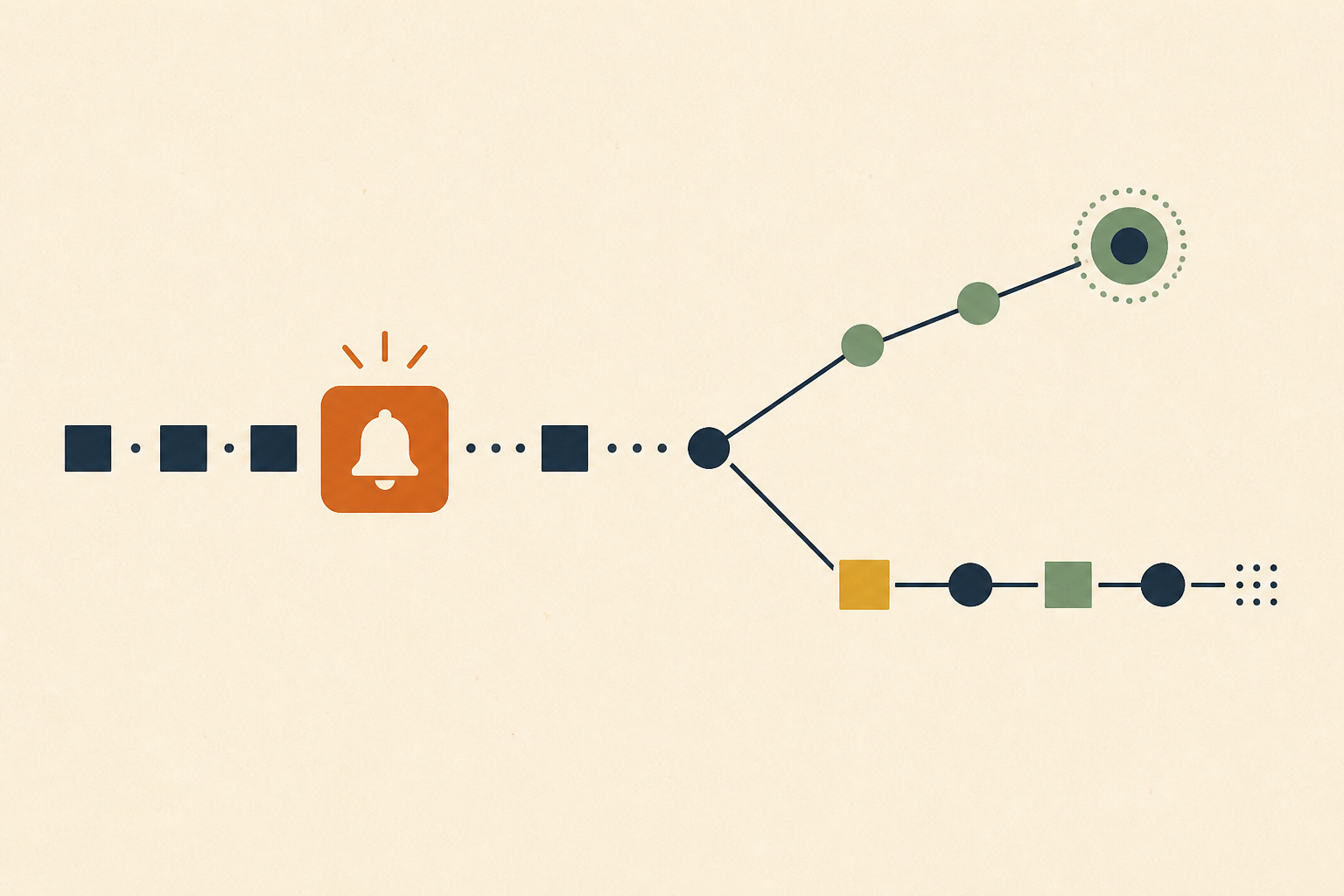
The primary hurdle in devops for startups isn't knowing that something is broken; it's knowing why. Setting up a Slack alert for a 500-error takes five minutes. Finding which line in a 2,000-line generated file caused that error can take five hours.
This "Investigation Gap" is where most solo founders burn out. You spend 80% of your MTTR (Mean Time To Recovery) just trying to reproduce the state of the system at the moment of failure. Without a dedicated SRE, this burden falls entirely on the person who should be building features.
Where AI helps and where it must not act
There is significant debate about whether AI will replace SREs. According to Vijijava, tools like K8sGPT can act as an "SRE Expert," but they aren't replacing engineers; they are removing the unstaffed toil.
For solo founders, the rule for AI in operations is: Read-only diagnosis.
Allow AI to ingest your logs, scan your Kubernetes events, and summarize the root cause. This speeds up the "finding" phase. However, never let an autonomous agent apply a fix to production without a human in the loop. The "vibe" that created the bug shouldn't be the same "vibe" that attempts to patch it in the dark.
The one-page runbook template
Copy and paste this into a README-OPS.md file in your repo.
Emergency Response Protocol
- Step 1: Mitigation. Can I turn off the broken feature? Can I rollback?
- Step 2: Evidence. Capture the last 50 lines of logs and the current
toporhtopoutput. - Step 3: Identification. Use an AI diagnostic tool or grep to find the first instance of the error.
- Step 4: Fix & Verify. Apply the fix to a staging branch first.
- Step 5: Post-Mortem. Write one sentence on why this happened and how to automate its detection next time.
Why this matters now
The barrier to entry for software has never been lower, but the "operational tax" remains high. As we see more "vibe-coded" startups hit the market, those who survive won't necessarily be those with the best code, but those who can stay online without a 10-person ops team.
Sources & further reading
- According to Samir Savla, alarms are superior to dashboards for founders who need to focus on growth.
- According to The New Stack, the lack of deep architectural knowledge in AI-generated apps is a looming production risk.
- According to Vijijava, AI experts like K8sGPT are becoming essential for managing infrastructure complexity.
Modern operations platforms are evolving to solve this "unstaffed middle." Platforms like Operate offer a reactive mode specifically designed for this scenario—allowing a lone founder to ask "why is checkout failing" in plain language and receive an evidence-backed answer. By bridging the gap between an alert and a root cause, you can go back to building while the AI handles the investigation.