A Pull Request Is Not a Review Gate. It Is Write Access With a Waiting Period.
TL;DR: While engineering teams rely on pull request reviews to secure AI-driven operations, opening a PR requires a write credential that creates immediate side effects. True safety for AI agents comes from decoupling the review surface (the diff) from the access level (the token), moving the gate from the merge back to the write itself.
The industry has converged on a single answer to the problem of AI agent safety: "A human reviews the PR before anything merges." This sentiment is echoed across the ecosystem, from product pages like OneUptime’s AI agent to practitioners like @fares7elsadek, who recently noted that a tool’s ability to open a PR is valuable specifically because nothing merges automatically.
This is a true statement, but it answers a different question than the one engineering leaders think they are asking. We are conflating a review surface with an access model.
Two things that get conflated
To secure a system, we must separate the review surface from the access level.
The review surface is the diff a human reads and the judgment they apply to the code change. The access level is what the agent’s credential is permitted to do the moment it produces that diff. Most teams operate under the assumption that a pull request is a passive container. It is not.
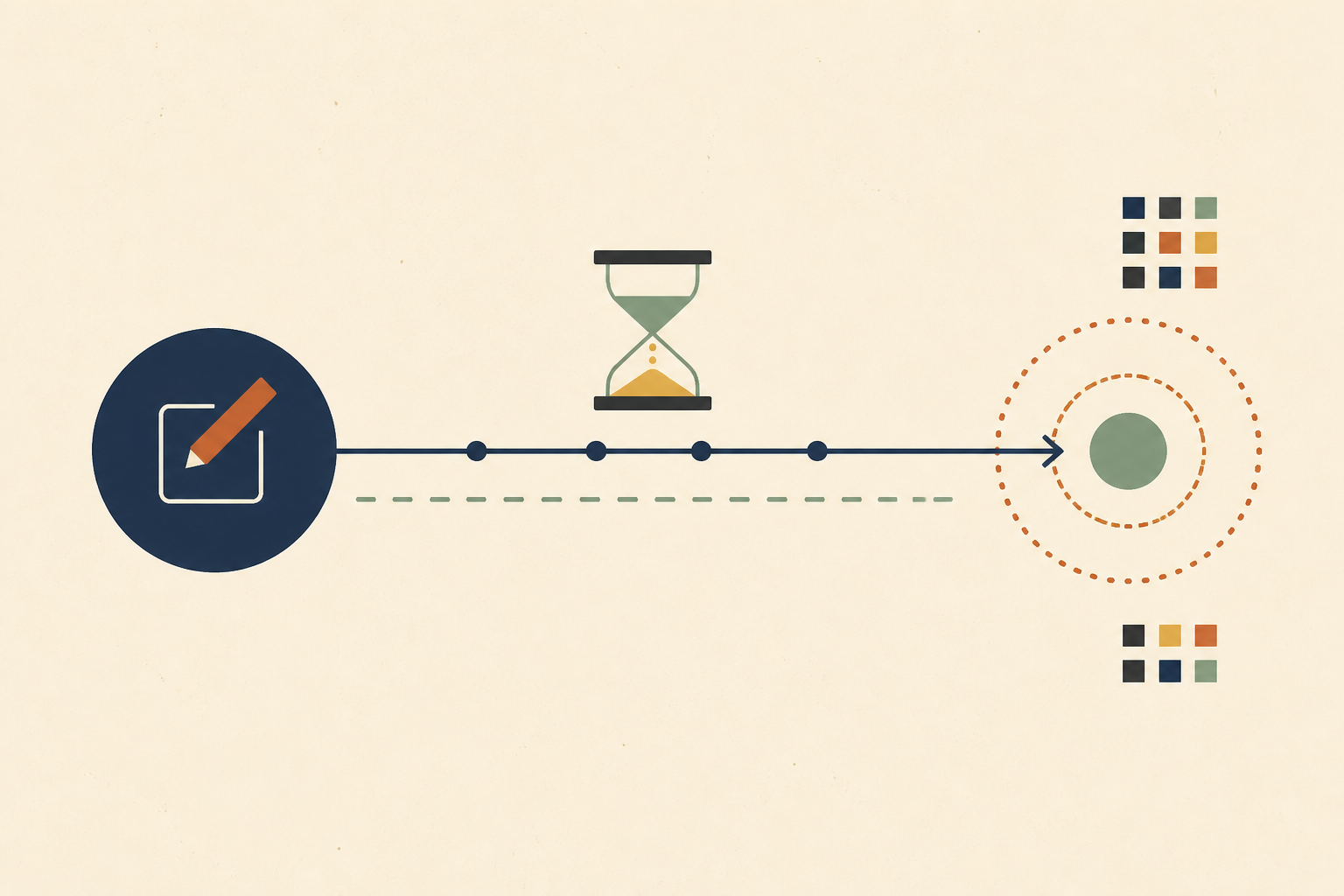
Opening a pull request is a write action. To create one, the agent requires a credential that can create branches and push commits. The "human gate" sits at the merge—which is exactly one step later than most people picture it. In that gap between the push and the merge, the agent is already inside the house.
Granting the strongest version of the other argument
There is a growing school of thought that agents should not be gated by simple human review, but by trust. As @jarjis argued on September 21, 2026, agents should "earn" execution rights through demonstrated per-stage success rather than self-reported confidence.
This is a rigorous, sensible position. Gating on a model’s self-reported confidence is effectively meaningless, as that number is generated by the same stochastic process whose reliability we are questioning. If the model is wrong about the fix, it is likely wrong about its confidence in that fix. @jarjis is correct that a track record of success is a better signal.
However, even a track record is not enough in production operations. Operational incidents are rarely drawn from a stationary distribution. An incident, by definition, is usually a case the system has not seen before or a failure mode that bypassed existing safeguards. A track record accumulated on yesterday’s incidents is the weakest possible evidence for the novel incident happening right now. Track records generalize where the distribution is stable; production is anything but stable.
The inventory: How a "gate" becomes a hallway
When you grant a credential that can open a pull request, you are trusting more than just the agent. You are trusting your entire CI/CD configuration. Here are concrete, checkable ways a write credential ends up doing more than the person who granted it intended:
- Workflows triggered on
pushrather thanpull_request: In both GitHub Actions and GitLab CI, many workflows are configured to run on every push to any branch. These scripts execute the moment the agent "opens a PR," long before a human has looked at the code. - Stale approvals surviving a force-push: Unless your repository is explicitly configured to dismiss stale reviews (a setting often disabled to reduce friction), an agent could theoretically push a "safe" commit, get an approval, and then force-push a different commit that retains the approved status.
- Inconsistent branch protection: You may have strict rules on
main, but what about the sibling branches the agent creates? If those branches trigger deployment previews or shared staging environments, the agent has effectively bypassed the production gate by attacking the environment next to it. - Accumulated bot scopes: A bot identity used for "opening PRs" often accumulates scopes across an entire organization over time. A credential meant for a single repository often has read/write access to dozens, creating a massive blast radius if the agent’s logic (or its underlying provider) is compromised.
- Auto-merge defaults: Many teams enable auto-merge for "non-breaking" updates. An agent-authored PR that appears to pass CI might trigger an auto-merge before a human intervenes if the repository rules aren't tuned for AI-authored changes.
Key Takeaway: A pull request is a write operation that triggers automated processes; therefore, the review gate only protects the merge, not the environment.
Reviewer fatigue is part of the access model
A review gate is only a gate while the reviewer is actually reading. The 2026 DORA (DevOps Research and Assessment) report indicates that while AI adoption correlates with higher throughput, it also correlates with higher instability. Similarly, Faros’s 2026 telemetry across 22,000 developers shows that incidents per pull request are rising sharply.
This suggests that a design which produces more pull requests eventually degrades the very gate it depends on. When a human SRE is faced with a queue of ten plausible agent-authored PRs, the depth of their scrutiny naturally declines compared to a single, manually authored fix. If your safety model relies on human judgment, you cannot ignore the throughput at which that judgment fails.
What a patch file changes, and what it does not
There is a way to preserve the review without granting the write: the patch file.
By having an agent output a patch file rather than opening a PR, you remove exactly one thing: the write credential. The human receives the diff, applies it, and opens the pull request themselves. The review still happens. The audit trail is still created. The difference is that the agent never held write access to your repository.
The cost is friction. For a one-line fix on a Friday afternoon, applying a patch manually is more work than clicking a merge button on a PR. For some teams, that convenience is worth the risk of a write credential. That is a defensible trade, provided it is made consciously.
Why this matters now
This distinction is becoming critical because we are moving from "AI assistants" to "human in the loop ai agents." In an assistant model, the human holds the pen. In the agent model, the agent holds the token.
At Operate, we chose a design that produces a patch file rather than opening a pull request by default. We did this because we believe in self-hosted, private AI that operates under strict auditability. By not requiring write access to your repositories, we ensure that the "human in the loop" isn't just a rubber stamp at the end of a process, but a true firewall at the beginning of the write cycle.
If you are evaluating how to integrate AI into your SRE workflows, ask yourself these five questions:
- What can our agent’s credential do right now, exactly, across all repositories?
- Which CI workflows run the moment the agent pushes a branch, before a human sees it?
- Does our repository configuration automatically dismiss approvals if the agent pushes a new commit to an open PR?
- How many agent-authored changes does a reviewer see in a week, and has the time-per-review decreased?
- If this same diff arrived as a file instead of a branch, what would we actually lose—and is it worth the token?
Sources & further reading
- According to @fares7elsadek in their review of AI monitoring tools, the primary value in the PR-opening pattern is the assurance that nothing merges automatically.
- According to @jarjis, agent autonomy should be a function of earned trust through per-stage success rather than self-reported confidence scores.
- The OneUptime AI agent product page illustrates the industry-standard pattern of turning incident findings into pull requests for human review.
- The 2026 DORA Report (via DORA.dev) highlights the tension between AI-driven throughput and system stability.