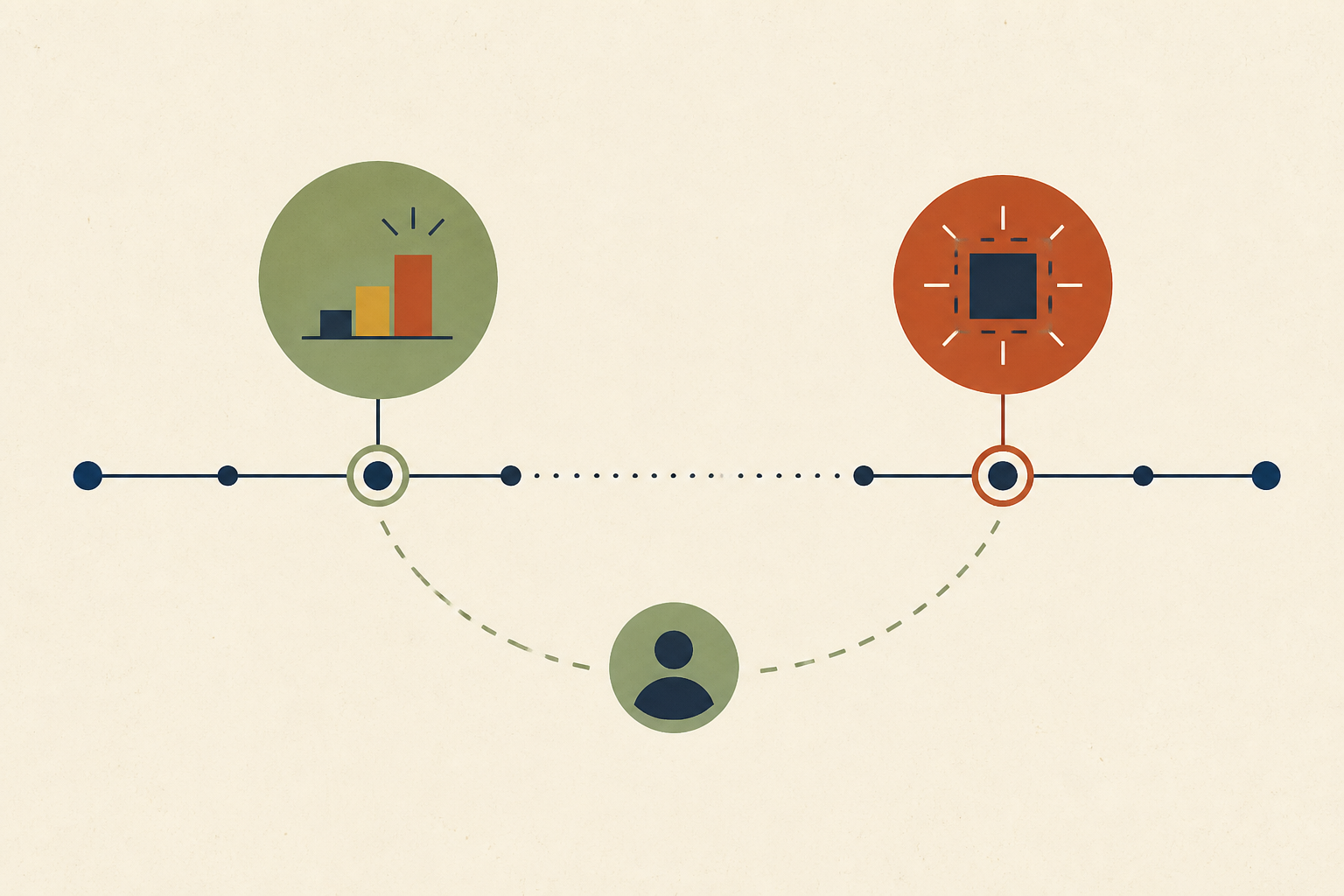
The Saving Is Booked in March and the Reliability Bill Arrives in July. Only One of Those Has an Owner.
TL;DR: A cloud cost reduction produces a fast, certain, and attributable number in the month it lands. The reliability consequence of that same change is a slow, uncertain, and unattributable cost that appears months later—often without a clear owner. This asymmetry leads organizations to optimize for immediate savings while unknowingly depleting the operational headroom required to survive incidents.
Two numbers with very different half-lives
In the calculus of modern infrastructure, two fundamental numbers compete for an engineering leader’s attention. The first is the cost saving: it appears on the next invoice, it is attributable to a specific pull request, and it is claimed by a named individual during a quarterly business review. The second is the reliability cost: it manifests as a few extra milliseconds of latency at p99, a log line that has aged out when you need it most, or a traffic spike that used to be absorbed but now triggers a cascade.
This is not a failure of culture; it is an imbalance of arithmetic. One number has a short, high-visibility half-life; the other has a long, silent decay. In any organization that measures both, the cost saving wins every time because it is the only one with a receipt.
| Metric Property | Cost Saving | Reliability Headroom Loss |
|---|---|---|
| Speed of Feedback | Instant (Next billing cycle) | Delayed (Months to years) |
| Certainty | Absolute ($ saved) | Probabilistic (Risk increased) |
| Attribution | Direct (Linked to a PR) | Indirect (Systemic failure) |
| Owner | The FinOps/Eng Lead | Nobody (The "On-call" victim) |
What a cost reduction actually removes
When we talk about "optimizing" a stack, we are rarely removing waste in the literal sense of doing nothing. We are usually removing margin. Concretely, this happens across the entire stack:
- Compute: Reducing instance sizes or counts removes burst headroom, leaving the system unable to handle organic growth or micro-bursts.
- Redundancy: Cutting replicas removes tolerance for concurrent failures. What was once a non-event becomes a partial outage.
- Observability: Shortening log or metric retention windows removes the historical context required to investigate complex, slow-burning incidents.
- Caching: Trimming cache TTLs or memory moves load directly onto the database, turning a latency blip into a queueing crisis.
- Networking: Reducing connection pool sizes converts transient network jitters into application-level failures.
- Environments: Downsizing non-production clusters removes the only environment where scale-dependent bugs could have been caught before hitting production.
According to the Microsoft Azure Well-Architected Framework, these trade-offs are well-documented. Azure explicitly lists "Reduced resiliency," "Reduced observability," and "Limited recovery strategy" as the direct costs of optimization. They note that decreasing log and metric volume to save on storage "produces coverage gaps in incident response activities." The mechanism of the loss is not controversial; the problem is that we treat it as a design-time choice rather than an ongoing debt.
Nobody is required to check
The structural flaw in how we manage infrastructure lies in the lack of a closed-loop process. The major cloud and reliability frameworks provide guidance on the front end but fall silent on the back end.
The AWS Well-Architected Cost Optimization Pillar (COST06-BP02) treats sizing primarily as a pre-deployment data exercise: you choose the resource type based on cost modeling data before the change goes live. The Google SRE Book frames the relationship between cost and reliability as a target-setting negotiation, explicitly endorsing the practice of running clusters "hot" with less redundancy to save money. However, in the Google model, the error budget gates releases, not capacity changes.
Key Takeaway: No major industry framework currently requires an engineering team to re-validate a system's reliability properties after a cost-saving change has been implemented.
There is no "check-back" step. Once the ticket is closed and the saving is booked, the new, lower level of headroom becomes the new baseline. No one is prompted to ask if the system can still survive its worst-case scenario three months later.
The evidence that is missing, and why that is the point
In researching this asymmetry, we searched the public record of postmortems for cases where a company explicitly attributed a major outage to a cost-motivated downsizing. We found none.
This absence is not evidence that cost cuts are safe; it is evidence that the attribution we described above simply does not happen. We see the mechanisms of efficiency fighting the responders in real-time, however. In Slack's January 4, 2021 postmortem, they describe how autoscaling machinery downscaled the web tier while engineers were actively logged into production instances, abruptly ending their SSH sessions and hindering the investigation.
Similarly, Honeycomb's February 2026 incident report details how data was irreversibly lost because it passed the Kafka retention window, and noted that their smaller pre-production clusters made the underlying flaw structurally unreproducible. In both cases, the limits were there—in the autoscaler, the retention window, and the staging size—but they were treated as static configurations, not as "spent" reliability. The causal link between a specific cost-saving initiative and these incidents is never written down, because nobody is asked to look for it.
The one piece of rigorous research that supports the delay
Why does the bill take so long to arrive? Research by Xu et al. (OSDI 2016) on latent configuration errors provides a technical explanation. They found that configuration parameters governing reliability and fault handling are frequently not checked at initialization. Between 14.0% and 93.2% of the parameters they studied had no correctness check at startup.
This means that a cost-cutting change—like reducing a retry timeout or a replica count—stays latent. It does not break the build. It does not break the deploy. It stays silent until the day the specific failure it was meant to handle finally occurs. Only then does the "latent" error manifest as severe damage. We are effectively flying a plane and removing the oxygen masks to save weight; you don't notice the weight is gone until the cabin depressurizes.
What a cost change should have attached to it
To fix this, engineering leaders must treat cost reductions as architectural changes, not just billing adjustments. Every cost-saving PR should require five specific attachments:
- A Pre-defined Guardrail: A reliability metric (e.g., p99 latency < 200ms) chosen before the change is made. If you choose it after, you will subconsciously move the goalposts to fit the new reality.
- A Baseline of the Spent Property: Explicitly state what is being traded. "We are reducing our burst headroom from 40% to 15%."
- A Delayed Review Date: A calendar invite for three to six months out. Most businesses need to cross a true seasonal peak (like Black Friday or end-of-quarter) to see if the new headroom holds.
- A Reversible Path: Ensure the decision is reversible. If you give up reserved instances or delete historical logs, the "rollback" is gone.
- An Assigned Owner: The person who claimed the credit for the saving must be the one responsible for the review date, not the on-call engineer who inherits the risk.
Where the FinOps discipline already agrees
The FinOps Foundation's State of FinOps 2026 report highlights a mirror image of this problem: "shift-left" measurement remains one of the discipline's greatest unsolved challenges. Their 2025 report noted that "workload optimization and waste reduction" was the top priority for 50% of practitioners. Meanwhile, Flexera’s 2026 State of the Cloud report shows wasted spend rising to 29% for the first time in five years, largely driven by AI workloads.
Waste is real, and cutting it is necessary. But as the "big rocks" of waste are cleared, teams are increasingly cutting into the margin that protects them from the unknown.
The challenge for modern engineering teams is that the review dates and guardrails mentioned above are often forgotten the moment the ticket moves to "Done." A change with a delayed consequence requires an automated way to watch for regressions across infrastructure, databases, and logs simultaneously. Without a mechanism to keep watching after the human has moved on, we will continue to book the savings in March and wonder why the bill is so high in July.
Sources & further reading:
- According to the FinOps Foundation, workload optimization remains the top priority for practitioners even as measurement remains a "shift-left" challenge. State of FinOps 2026
- According to Flexera, wasted cloud spend has risen to 29%, the first increase in five years. 2026 State of the Cloud
- According to Microsoft Azure, cost optimization frequently involves explicit tradeoffs with resiliency and observability. Azure Well-Architected Framework
- According to Xu et al., up to 93% of configuration parameters may lack startup checks, leading to latent failures. OSDI 2016: Early Detection of Configuration Errors
- According to Slack, autoscaling mechanisms can inadvertently disrupt incident investigation by terminating active sessions. Slack Engineering Blog