Seventy-Two Milliseconds Apart, Both Inertial Systems Failed. They Were Copies, Not Alternatives.
TL;DR The destruction of Ariane 501 was not caused by a simple software bug, but by a failure of redundancy design where two identical systems failed for the same deterministic reason just 0.05 seconds apart. True fault tolerance requires diversity, not just replication; without it, redundant components act as a single point of failure when faced with logic errors or shifting operational envelopes.
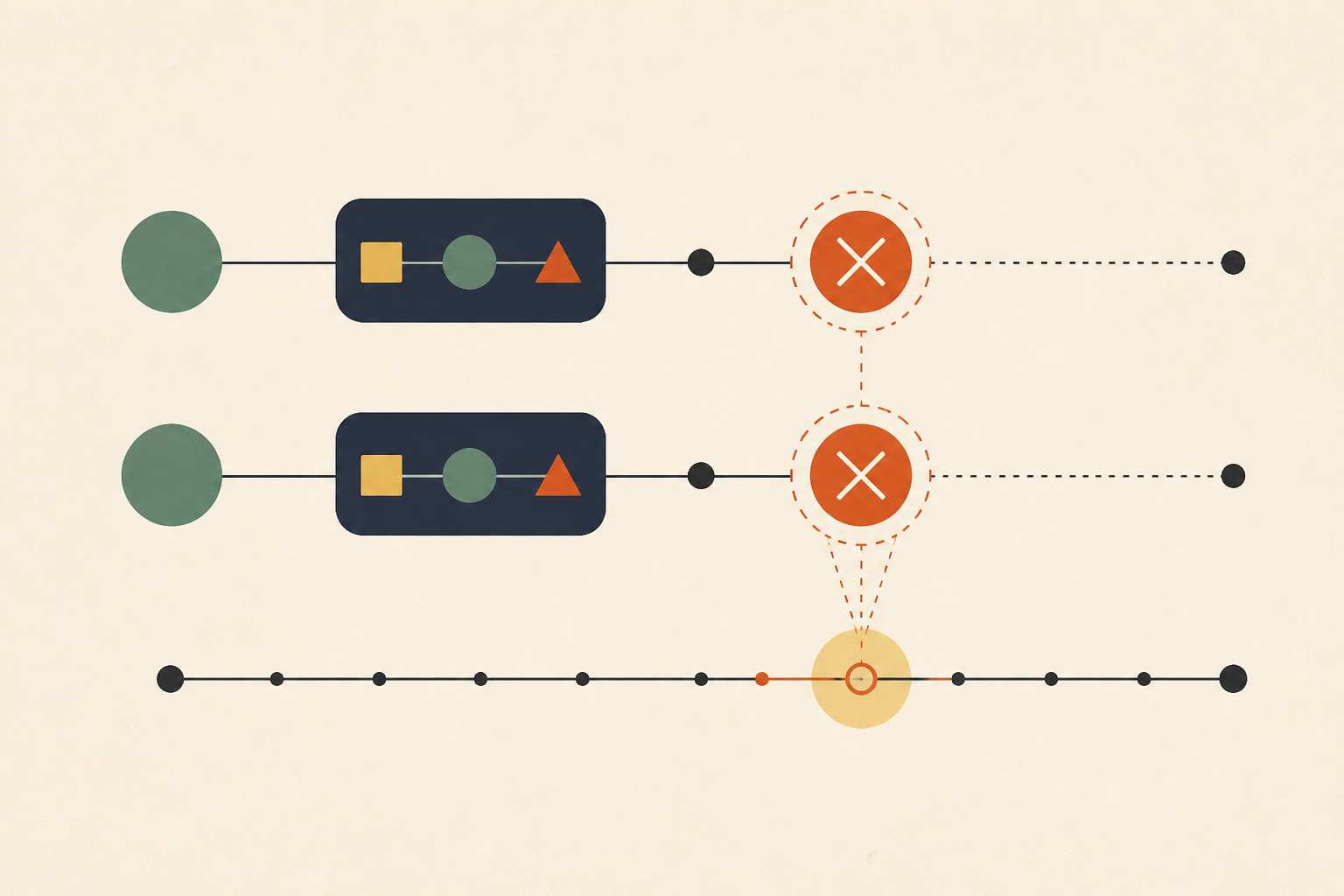
At H0 plus 36.7 seconds, the backup inertial reference system (SRI 2) of the Ariane 5 launcher stopped. Approximately 0.05 seconds later, the active unit (SRI 1) stopped for the exact same reason. Thirty-seven seconds after ignition, the launcher had no guidance at all. At 39 seconds, it disintegrated.
The industry usually remembers this as the "most expensive integer overflow in history." But the overflow—a 64-bit float to 16-bit signed integer conversion that exceeded its range—is the least interesting fact in the inquiry. The critical observation is the 0.05 seconds. The failure was not a component dying at random; it was a deterministic logic failure executed twice.
What the board actually found
The Inquiry Board, chaired by Professor J.L. Lions, produced a report that remains a masterclass in forensic engineering. Investigators recovered both SRI units from twelve square kilometers of mangrove swamp and successfully read the failure context out of their EEPROMs (finding e).
This data revealed a chain of events that were entirely logical according to the system's specifications. The software encountered an operand error during a data conversion. Because the specification dictated that any software exception should result in a processor shutdown, both units simply ceased to function (finding m). The board noted that the failure was not due to a lack of redundancy, but a lack of redundancy vs diversity fault tolerance.
Redundancy is not diversity
The Ariane 501 architecture featured two identical units running identical software on identical hardware. One was active, the other in hot standby. When SRI 2 failed, the switchover mechanism worked perfectly—it looked to SRI 1, which had already failed for the same reason (finding f).
Key Takeaway: Replication defends against independent hardware failures, but it offers zero protection against deterministic logic errors where correlated inputs produce correlated failures.
According to the Lions Report, the loss of a proper software function is hazardous specifically "because the same software runs in both SRI units." This is a lesson modern SREs often learn the hard way:
- Three identical pods behind a load balancer will all crash if a specific "poison pill" request hits them.
- Multi-region deployments running the same container image will fail simultaneously if a time-triggered bug exists.
- Database replicas running the same query planner version will all hang on the same problematic execution plan.
The function that had no reason to be running
The failing code was an alignment routine. It served a vital purpose before liftoff to ensure the rocket knew its orientation. However, it continued to run for approximately 40 seconds into the flight—a legacy requirement from the Ariane 4 (finding h).
In the Ariane 4, this allowed for a quick restart of the countdown in the event of a hold. This feature had been used exactly once, in 1989. For Ariane 5, the requirement no longer existed, yet the code remained. The board’s Recommendation R1 is a single, haunting sentence: "Prepare a justification document for each software unit... indicating that no software function should run during flight unless it is needed."
We see this daily in modern production: the sidecar proxy nobody owns, the migration flag still being evaluated three years later, or the cron job whose output is no longer read. These components are "safe" only as long as the input distribution remains static.
The margin argument that was true until it was not
The decision to leave the 64-bit to 16-bit conversion unprotected was not an oversight. It was an intentional engineering trade-off. Seven variables were analyzed for potential overflow; four were protected, and three—including the one that failed—were not (finding p).
The decision was based on a "physical margin" argument: the variable's value could not physically exceed the limit based on the trajectory of the Ariane 4. However, Ariane 5 was a different machine. Its trajectory built horizontal velocity five times faster than its predecessor (finding n). The assumption was documented but, as the board puts it, "essentially obscured from external review."
This highlights a common pitfall: assumptions recorded in a justification document rather than enforced in code survive into new environments where they are no longer true. According to the Lions Report, engineers must identify all implicit assumptions (R5) and give justification documents the same scrutiny as the code itself (R12).
Failing loudly in the wrong direction
When the SRI units failed, the exception handler shut down the processors. As a final act, the units transmitted a diagnostic bit pattern on the databus. The on-board computer (OBC) did not recognize this as an error code; it interpreted the bit pattern as valid attitude data (finding g).
The OBC then commanded a full nozzle deflection to "correct" a deviation that had not occurred. The rocket essentially steered itself into its own destruction. Recommendation R3 states: "Do not allow any sensor to stop sending best-effort data." In modern terms, a component that reports a status which is structurally valid but semantically meaningless—like a health check returning 200 OK while the backend is in a deadlock—is more dangerous than a component that simply goes silent.
What this says about checking a model with a model
This historical failure provides a clear design constraint for modern AI-assisted operations. If the objection to using an automated reasoner for root cause analysis is that it can be confidently wrong, then verifying that output with a second instance of the same model is not a meaningful check. It is SRI 2 following SRI 1 into the swamp.
A second instance of the same model, given the same evidence and prompt, is likely to reach the same erroneous conclusion. This is why Operate’s verification stage intentionally runs on a different model from the one that produced the initial root cause analysis. Diversity in reasoning is the only way to break the deterministic failure loop.
Why this matters
The Ariane 501 failure is often cited as a cautionary tale about "testing," but that misses the point. The software worked exactly as it was designed and specified. The failure was one of architectural assumptions. As engineering teams move toward higher levels of automation, the risk moves from "random component failure" to "systemic logic failure."
Common Pitfalls
- Assuming redundancy equals reliability: Doubling the count of identical components only protects against hardware "wear out," not software "design out."
- Shadow Code: Allowing legacy routines to run in new environments without re-validating the physical constraints of those environments.
- Silent semantic failures: Designing systems that return default or diagnostic values that downstream consumers might mistake for valid telemetry.
Five questions for your next architecture review:
- Are our replicas different in any respect that matters, or are they just copies?
- What code is running in production that provides no value to the current request path?
- Which physical or logical assumptions exist only in a design doc and not in a guardrail?
- When a component fails, does it go quiet or does it keep talking nonsense?
- What is the downstream consumer configured to believe if the upstream fails?
Sources & further reading
- According to the Lions Report, the failure was a direct result of "redundancy without diversity."
- The ESA Bulletin 89 details the recovery and the shift in verification culture following the flight.
- ACM SIGSOFT notes that the reuse of Ariane 4 software without re-verifying Ariane 5 constraints was the primary procedural error.